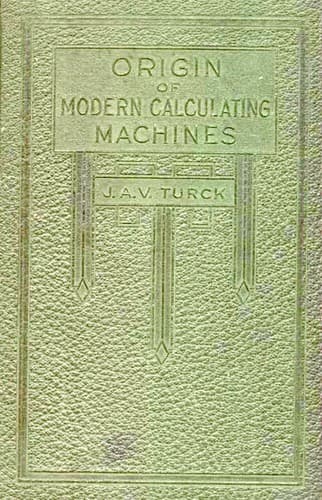
Origin of modern calculating machinesTurck, J. A. V.
History
Origin of modern calculating machines
Turck, J. A. V.
Calculators
The denominational actuators in the Burroughs machine were not provided
with spring tension that would cause them to act as soon as unlatched
by depression of the keys as has been described in relation to the
Pottin invention.
While the keys in the Burroughs machine, as in the Pottin invention,
served also to unlatch the denominational actuators in their respective
orders, no movement of the said actuators or type-wheels took place
until a secondary action was performed.
The secondary action, or the operation of the hand lever, marked C⁵,
attached to the shaft C, on its initial or forward stroke dragged the
denominational actuators down by means of friction and thus set the
type-wheels, and by means claimed in the specification, brought about
the type impression to print the result of the key-setting or the item
so set.
The backward or rear stroke of the hand lever caused the accumulator or
total numeral wheels to be engaged and the item to be added to them.
From this single lever action it will be noted that there is an
improvement shown over and above the Pottin invention in the fact that
but one lever motion is required; Pottin having provided two levers so
that in the event of error the operation of one lever would reset the
machine without performing any addition or printing.
In the Burroughs invention, the motion of denominational actuators and
their type-wheels not being effected through depression of keys, as in
the Pottin machine, allowed any error in the setting up of an item to
be corrected by the resetting of the keys and relatching of the gears,
which it is claimed was provided for by operation of the lever marked
B⁷ (Fig. 1 of the drawings).
As a means of supplying power to his denominational actuators,
Burroughs provided what may be called a universal actuator common to
all orders, composed of a rock-frame (arms D², loose on each end of
actuating shaft C, and having their outward ends rigidly connected by
the bar a⁹) and the arms E, fixed to each end of the shaft C.
Projecting from the inside of each of the arms E, are two lugs, b¹ and
b³, which contact with the arms D² of the rock-frame as the shaft C is
rocked back and forth by its hand crank C⁵, and thus lower and raise
the rock-frame.
The means employed to transmit the reciprocating action of the
universal actuator to such denominational actuators as may be unlatched
by key depression, consists of a series of spring-pressed arc-shaped
levers D¹, pivoted to the rock-frame bar a⁹, which bear against a pin
b² fixed in the front arm of the denominational actuators.
Each of the levers D¹, is provided with a notch y, which serves on
the downward action of the rock-frame to engage the pins b², of the
denominational actuators and draw down with them such actuators as have
been unlatched by key depression and to pass over the pins of such
actuators as have not been unlatched.
Public-domain text, read in full here on John Shaqi.
Reviews
Reviews
No reviews yet
Be the first to share your thoughts on this work.
Join the Discussion
Join the discussion
Sign in to leave a comment or review.
Sign InorCreate an account