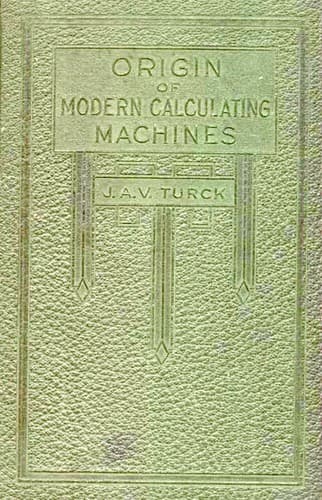
Origin of modern calculating machinesTurck, J. A. V.
History
Origin of modern calculating machines
Turck, J. A. V.
Calculators
The key-driven machine, which was the first produced of these two
types of modern machines, does not print, and is used for all forms of
calculation, but is generally behind the scenes in the accounting rooms
of all lines of business, and for that reason is not so well known as
the key-set crank-operated or motor-driven machine, which is designed
to print and is always in full view in the bank where it is used to
print your statement of account from the vouchers you have issued.
When we stop to analyze the qualities of these two types of machines,
we find that each has its place and that neither may truly serve to
displace the other. The organization of each is designed with reference
to the special work it was intended to do.
The calculating machine, having only to perform the work of
revolving the numeral wheels in calculating addition, subtraction,
multiplication and division in its many forms and combinations, may
be key-driven (on account of the slight mechanical resistance met with
in action), and thus, as a one-motion machine, requiring only the
depression of the keys, may also be much more rapid of manipulation
than the two-motion recording-adding machine which, after depressing
the keys for each item, requires the secondary operation of pulling a
crank forward or operating a push bar that connects the motor.
The recording-adding machine being designed to print the items and
answers of addition, requires power for the printing which cannot be
supplied by key depression. Thus an extra means for supplying that
power must be provided in the form of a crank lever, or in the latest
machines by a motor. The keys in such machines serve only as digital
control to gauge the setting of mechanism which prints the items and
adds them together. The secondary motion operates the mechanism to
print and add and finally to clear the machine for the setting up of
the next item. The recording of added columns of figures requires that
the answer must always be printed. This demands special operation of
devices provided for that purpose, which also adds to the time spent
in the operation of such machines as compared with the key-driven
calculator.
[Sidenote: _Recording, the primary feature of adding machines that
print_]
To state which of these two types of machines is the more useful would
cause a shower of comment, and has nothing to do with the object of
this article. Suffice it to say that where a printed record of items
added together with their answer is required for filing purposes,
or to bring together loose items like those in your bank statement,
the recording-adding machine serves; but when rapid calculation in
addition, multiplication, subtraction or division, or when combinations
of these forms of calculation are required, the key-driven calculator
is the practical machine for such work.
Public-domain text, read in full here on John Shaqi.
Reviews
Reviews
No reviews yet
Be the first to share your thoughts on this work.
Join the Discussion
Join the discussion
Sign in to leave a comment or review.
Sign InorCreate an account