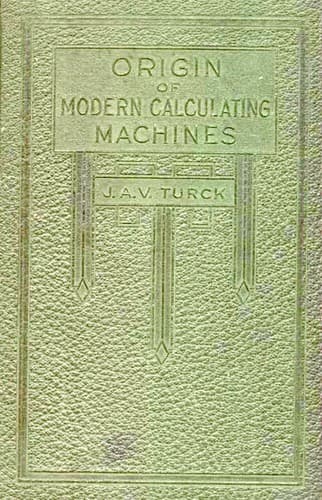
Origin of modern calculating machines — John Shaqi
Origin of modern calculating machinesTurck, J. A. V.
History
Origin of modern calculating machines
Turck, J. A. V.
Calculators
Although the key-driven calculator is generally not so well known, it
is, as stated, the oldest of the modern accounting machines, and its
usefulness places it in the accounting room, where it is oft-times
found employed by the hundreds in figuring up the day’s work of
accounting.
[Sidenote: _Validity and priority of invention_]
The purpose of this book is based wholly upon showing the validity and
priority of invention which constitute true contributions to the Art of
these two types of modern accounting machines; to place the facts for
once and all time before the public in such a way that they may judge
for themselves to whom the honor is due and thus settle the controversy
that exists.
The quibbling of court contests over the terminology of claims of
patents owned by the various inventors have been set aside and only
the true contributions to the Art which pertain to the fundamental
principles that have made the modern machines possible, are here dealt
with.
The dates of patents on inoperative or impractical machines have from
time to time been held up to the public as instances of priority of
invention; but when the validity of these patents, as furnishing any
real contributions to the Art, is questioned, they are not found to
hold the theme or principle that made the modern machines possible, and
as inventions, fade into obscurity.
[Illustration: _Figure 1_]
[Illustration: _Figure 2_ One of the Pascal Machines]
The Art of either the calculating machine or the adding-recording
machine is not new; it is, as a matter of fact, very old. As before
stated, the Art of “accounting machine” dates back to the tenth
century, but the first authentic evidence of a working machine is
extant in models made by Pascal in 1642 (see illustration).
THE PASCAL MACHINE
Referring to the illustration, Fig. 1, of Pascal’s machine on the
opposite page, it will be noted that there are a series of square
openings in the top of the casing; under these openings are drums, each
numbered on its cylindrical surface.
[Sidenote: _Description of Pascal’s invention_]
As the machine illustrated was made to figure English currency, the two
right-hand wheels are numbered for pence and shillings, while the six
wheels to the left are numbered from 1 to 9 and 0 for pounds.
[Illustration: Blaise Pascal]
The pounds register-drums, or numeral wheels, are each operated by a
train of gearing connecting them with a ten-armed turnstile wheel which
form the hub and spokes of what appears to be a series of wheels on the
top of the casing. While the spokes and hub are movable, the rims of
these wheels are stationary and are numbered from 1 to 9 and 0.
The geared relation between the turnstile wheels and the numeral wheels
is such that rotating a turnstile will give like rotation to its
numeral wheel.
Public-domain text, read in full here on John Shaqi.
Reviews
Reviews
No reviews yet
Be the first to share your thoughts on this work.
Join the Discussion
Join the discussion
Sign in to leave a comment or review.
Sign InorCreate an account