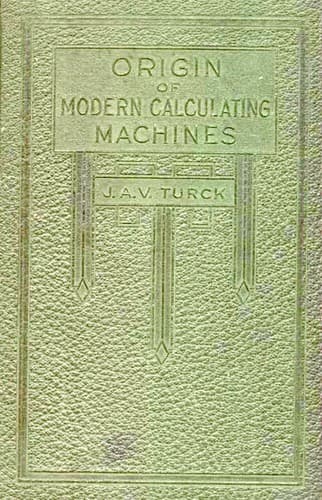
Origin of modern calculating machinesTurck, J. A. V.
History
Origin of modern calculating machines
Turck, J. A. V.
Calculators
The necessity of operating from right to left and the necessity of
printing the totals by key depression were features that, in view of
there being nothing better in those days, did not seem objectionable to
those who used them. They were features, however, that Felt overcame
and eliminated in the next lot of machines manufactured and placed on
the market in 1890.
[Illustration: FELT'S COMPTOGRAPH
One of the Early “Comptographs”]
This lot of machines, one hundred in number (a goodly number in those
days), were equipped with a special hand-knob in front on the left side
for automatically printing the totals, and with means by which the
ciphers were printed only on operation of the paper shift-lever, which
allowed the operator to depress the keys from left to right or any way
he pleased.
[Sidenote: _Felt recorder in “Engineering” of London, Eng._]
The best evidence as to what these machines looked like is to be found
in the reproduction on the opposite page of an illustration which
appeared in “Engineering” of London, in 1891.
It will be noted that the patent drawings of the Felt calculator are
also displayed. They were used to describe the adding mechanism of the
recorder.
The total printing device is shown and described in patent No.
465,255, while the patent for the printing of the ciphers by the hand
shift-lever was not applied for until 1904.
It may be argued, and argued true, that these two later features in
their generic application to the recording-adding machine Art were
anticipated by Burroughs in his invention herein previously described.
But, assuming that these features were operative features in the
Burroughs machine, they could not be claimed in combination with a
printing mechanism that was operative to give practical results and in
themselves did not make the recording-adder possible. Nor was the means
shown for recording the totals of use except with means for legible
recording.
[Sidenote: _Total recording a Felt combination_]
[Sidenote: _Legible listing of items and automatic recording of totals
first achieved by Felt_]
There is no desire to discredit what Burroughs did, but let the credit
for what Burroughs accomplished come into its own, in accordance with
the chronological order in which it may be proved that Burroughs
really produced a machine that had a practical and legible recording
mechanism. Then we will find that to produce such proof we must accept
the fact that in all the successful recording machines manufactured and
sold by the Burroughs Adding Machine Co., the printing type-sector, the
printing type-hammers and the overlapping hammer-triggers with their
broad functioning features forming a part of Felt’s invention, have
been used to produce legible recording, and that the combination of
practical total printing was dependent on Felt’s achievement.
[Illustration: Gottfried Wilhelm Leibnitz]
Public-domain text, read in full here on John Shaqi.
Reviews
Reviews
No reviews yet
Be the first to share your thoughts on this work.
Join the Discussion
Join the discussion
Sign in to leave a comment or review.
Sign InorCreate an account