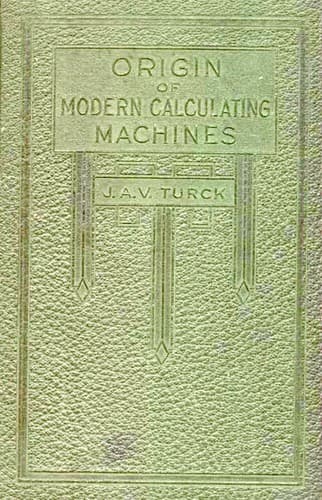
Origin of modern calculating machinesTurck, J. A. V.
History
Origin of modern calculating machines
Turck, J. A. V.
Calculators
We might say that broadly Burroughs invented means that could be worked
in combination with the Felt printing scheme to automatically print the
totals, which is in evidence in all the practical machines put out by
the Burroughs Co.
But such a combination was first produced by Felt in 1890, and was not
produced by Burroughs until 1892.
As has been shown, Felt built his recording scheme into his key-driven
calculating machine, and added the paper shifting-lever to furnish the
power which was utilized finally for setting the printing-hammers and
tripping them for the ciphers.
Such a combination divided the work, but made a two-motion machine,
whereas the adding mechanism was designed on the one-motion principle.
Now the principle of the two-motion machine was old, very old. The
great Gottfried Leibnitz invented the first two-motion calculator in
1694. (See illustration on opposite page.)
The Leibnitz machine was a wonderful invention and there seems to be a
question as to its operativeness. As a feature of historic interest,
however, it created considerable commotion in scientific circles when
exhibited to the Royal Society of London.
[Illustration: Leibnitz Calculator, made in 1694
The First Two-Motion Machine Designed to Compute Multiplication by
Repeated Addition]
The first really practical machine of this type, however, was invented
by a Frenchman named Charles Xavier Thomas, in 1820, and has since
become known as the “Thomas Arithmometre.”
The Thomas machine is made and sold by a number of different foreign
manufacturers, and is used to a considerable extent in Europe and to a
limited extent in the United States.
[Sidenote: _The key-set principle more practical for recorders_]
But two-motion calculators, from Leibnitz down to date, have always
been constructed so that the primary or first action involved merely
the setting of the controlling devices and performed no function in the
supplying of power to operate the mechanism which does the adding. With
such machines the load was thrown on to the secondary action.
This, of course, made the primary action of setting, a very light
action, especially when keys came into use, and as there are several
key depressions to each secondary or crank action, it may be understood
that while the action of Felt’s printing or paper shift-lever was
light, the action of the keys which were called upon to perform most
of the work was much harder than it would have been if his adding
mechanism had been designed on the key-set crank-operated plan of
the regular two-motion machine such as illustrated in the Pottin or
Burroughs patents described.
Public-domain text, read in full here on John Shaqi.
Reviews
Reviews
No reviews yet
Be the first to share your thoughts on this work.
Join the Discussion
Join the discussion
Sign in to leave a comment or review.
Sign InorCreate an account