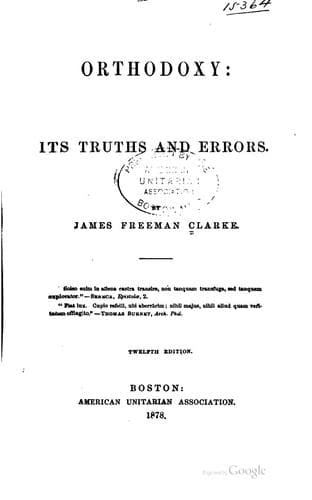
Orthodoxy: Its Truths And ErrorsClarke, James Freeman
Religion
Orthodoxy: Its Truths And Errors
Clarke, James Freeman
Unitarianism
Common sense and the analogies of common life must answer, “Both.” If
Christianity is a life, it must begin with a birth; if a journey, it
cannot be taken except we set out; if an education, we must determine to
commence the education; if labor in God’s vineyard, we must go into the
vineyard, and begin. There are only two classes—those who are alive, and
those who are not alive; those who are taking the journey, and those who
have not yet set out; those who are studying, and those who have not yet
begun to study; those who are at work for God, and those who are standing
idle. The distinction into two classes seems, therefore, substantial and
real. It does not follow, to be sure, that these two classes can be
distinguished so easily by the eye of man; but they certainly can be by
the eye of God. Nor does this primary distinction interfere with other
distinctions and many degrees of difference—greater or less differences
and degrees of progress, usefulness, goodness. Nor does it follow that
those who are now on the right side may not change again to the wrong, and
again to the right. There may be conversion, and _re_-conversion; but
that, at any moment, every person must be either endeavoring to do right,
or not so endeavoring, is evident. This view is confirmed by the New
Testament: “No man can serve two masters.”
That in the religious life there should be both crisis and development,
accords with the analogies of nature. The seed lies in the ground in a
dormant state, perhaps for a long period. After a time comes a crisis;
thrills of life vibrate through it; the germ is stirred; it sends its
roots downward; its stalk pierces the mould, moving upward into light and
air. After this great change, there comes a period of progress and
development. The plant grows; its roots multiply; its stalk ascends, and
divides into leaves. Then there comes a second crisis. The plant blossoms.
In the course of a few hours, after weeks of growth, the bud bursts into
beautiful petals, surrounding the delicate stamens and precious pistil.
Then there comes a second long period of slow development. The petals
fall, and the fruit slowly swells through many weeks of growth. At last
there comes a day when the fruit is ripe. Yesterday it was not ripe;
to-day it is. This is the third crisis. And so, in human life, long
periods of development terminate in critical hours—the seeds of another
long growth. So it is in other things; so also in religion.
§ 3. Nature of the Change.
Public-domain text, read in full here on John Shaqi.
Reviews
Reviews
No reviews yet
Be the first to share your thoughts on this work.
Elsewhere in the archive
Join the Discussion
Join the discussion
Sign in to leave a comment or review.
Sign InorCreate an account