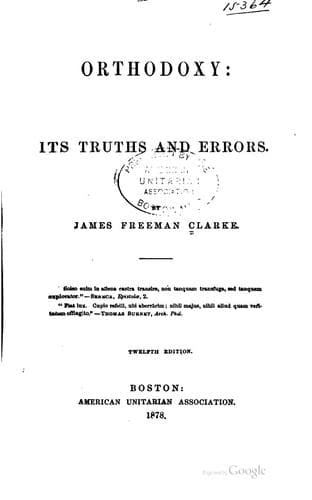
Orthodoxy: Its Truths And ErrorsClarke, James Freeman
Religion
Orthodoxy: Its Truths And Errors
Clarke, James Freeman
Unitarianism
The next position of Orthodoxy is, that man, in the second or regenerate
state, is a new creature. It asserts the change to be entire and radical,
and the difference immense. Not only the whole direction of the life is
changed, but the motive power is different, and the spirit different.
Instead of ambition, there is content; in the place of sensitive vanity,
there comes humility; instead of anxiety, trust in God. The burden of sin
is taken away; the sense of our unworthiness no longer torments us: for
God has forgiven our sins. Duty no longer seems arduous and difficult; for
there is joy in doing anything for the sake of God. The law is written in
the heart. We are born into a new life, the principle of which is faith.
“The life I now live in the flesh, I live by faith in the Son of God.”
This faith enables us to see God as he is, not as a stern King, or a
distant Power, or an abstract Law, but as a Friend, Father, watchful
Providence, surrounding Love, inflowing Life; Source from which we are
always coming, and towards which we are always tending. This life of faith
makes all things new. Old things have passed away, and the outward world
is fresh as on the first morning of creation. Our inward and outward life
are both new. We have new convictions, new affections, new aims, new
hopes, new joys. Nature is new, life is new, the Bible is new, the future
world is new. Such and so great is the change which Orthodoxy assumes as
the result of conversion.
§ 4. Its Reality and Importance.
And the experience of the whole Church, the biographies of the saints in
every denomination, assure us of the substantial truth of this
description. Even in churches which are not Orthodox,—churches like our
own, which insist more upon development than upon crisis,—observation
verifies this description. Even those who do not expect such a change, nor
believe in it, often come to it unexpectedly. In the course of each one’s
experience as a Christian minister, though he may never have insisted on
the importance of sudden changes, and though he may be no revival
preacher, he must have known numerous instances of those who seem to have
passed from death to life in the course of a day or an hour. And is not
this change, either sudden or gradual, that which makes Christianity a
gospel? It is the good news, not of a future and distant heaven, but of a
present heaven,—a heaven not outward, but inward; a present salvation from
the power of sin; a present relief from the sense of guilt; a present joy
and peace in believing; happiness in serving God; sympathy and good-will
to man, instead of envy and uncharitableness; peace with God, with man,
with ourselves, with our condition and circumstances.
That such a state is possible for every human being who desires it, is the
good news which Christ brings; and the experience of ten thousand times
ten thousand grateful hearts declares that it is a reality.
Public-domain text, read in full here on John Shaqi.
Reviews
Reviews
No reviews yet
Be the first to share your thoughts on this work.
Elsewhere in the archive
Join the Discussion
Join the discussion
Sign in to leave a comment or review.
Sign InorCreate an account