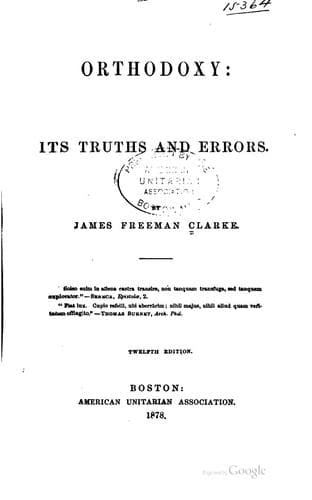
Orthodoxy: Its Truths And ErrorsClarke, James Freeman
Religion
Orthodoxy: Its Truths And Errors
Clarke, James Freeman
Unitarianism
§ 5. Is it the Work of God, or of the Man himself? Orthodox Difficulty.
But now comes a difficulty in the Orthodox statement. Orthodoxy declares
that this regenerate state is the result of faith, not of works; and that
faith is the gift of God; and herein Orthodoxy follows the Scripture. Yet
Orthodoxy calls upon us to repent and be converted, that our sins may be
blotted out; and herein likewise Orthodoxy follows the Scripture. Is,
then, conversion an experience, or is it an action? Is it something God
gives, or something which he commands? Is it a duty to be done, or a gift
to be received? Is it submission to his will, or joy in his love? a new
life of obedience, or a new heart of faith? If it is submission, then we
can all change our hearts at once, and make ourselves love God and love
man. But who can love by an effort of the will? Yet, if the new life is a
gift, then we have no power to procure it, and can only wait till God sees
fit to send it; and how, then, can we be called upon to be converted?
Here is a difficulty which it seems to us Orthodoxy does not solve; and
yet we think that a solution is to be found in a very simple distinction,
which, like all other true and real distinctions, throws light on many
other difficulties.
§ 6. Solved by the Distinction between Conversion and Regeneration.
The distinction of which we speak is between repentance or conversion on
the one side, and regeneration or a new life on the other side. Repentance
or conversion consists in renouncing all sin, and resolving to forsake it;
in turning to God, with the purpose of submitting to his will and obeying
his law. This conversion or repentance is an act proceeding from the will,
and in obedience to the conscience. This is what God commands, and what we
can and ought to do. Every conscientious person, every person who is
endeavoring to do right and is ready to act up to his light, is a
converted person. Every one who hates his sins, resists temptation,
watches and prays against it, is a penitent person. This is the great,
broad distinction between man and man. This divides all men into two
classes—those who, in their will and purpose, are for God, truth, and
right; and those who, because they are not _for_ God, are really _against_
him.
But, besides this broad distinction, there is another secondary
distinction—a distinction among those who are conscientiously endeavoring
to do God’s will. Among the _converted_ there are two classes—the
regenerate and the unregenerate. A man may be converted, and not be
regenerate; for a man may repent of his sin and turn towards God, and yet
not have the life of love and joy which we have described.
He is under law, not under grace. He is struggling to do right, but is not
borne forward on a joyful tide-wave of love.
§ 7. Men may be divided, religiously, into three Classes, not two.
Public-domain text, read in full here on John Shaqi.
Reviews
Reviews
No reviews yet
Be the first to share your thoughts on this work.
Elsewhere in the archive
Join the Discussion
Join the discussion
Sign in to leave a comment or review.
Sign InorCreate an account