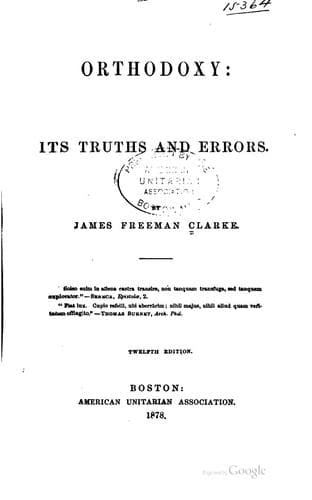
Orthodoxy: Its Truths And ErrorsClarke, James Freeman
Religion
Orthodoxy: Its Truths And Errors
Clarke, James Freeman
Unitarianism
If this be so, we may divide men into three classes, and not into two. The
first class is of those who are neither converted nor regenerate; the
second, who are converted, but not regenerate; the third, who are
converted, and also regenerate. The first are like the prodigal in the
parable,—living without God; the second, like the hired servants in the
same story,—serving God for wages; the third are sons, serving from love,
ever with their Father, and all that he has is theirs. The motive of the
first class is selfish will, selfish pleasure; the motive of the second is
duty; that of the third, love. The first are without law, the second under
law, the third under grace. And so we might multiply distinctions. But is
it not clear to common observation, that this threefold classification
meets the facts of life better than the other? There are three degrees of
character. There is the worldly man, who is just as good or bad as society
around him leads him to be; whose virtues result merely from a happy
organization, or fortunate influences, but who has no principle of
goodness, no purpose of righteousness, no serious aim in life. Then there
is the conscientious man, who means to live, and does live, by a standard
of morality; who has a serious aim, but who is not yet deeply and joyfully
religious; whose religion, at any rate, is hard work, not confiding,
child-like faith. And then there is the Christian believer, who has begun
to live from faith; who begins to feel a higher life pouring into his
heart from on high; who has help and strength from above. From his heart
the burden has been lifted, and he has become again as a little child. He
knows how to pray the prayer of faith. He may not be so very much better
than the other in outward character; but he has the principle within him
which will make all things new, sooner or later.
The New Testament confirms this view of a threefold division. We saw, in
our last chapter, that the apostle Paul, who considers human nature to
consist of three elements,—spirit, soul, and body,—divides mankind into
the carnal man, the natural (psychical or soulish) man, and the spiritual
man. The carnal man is he in whom the bodily instincts and appetites are
supreme. “He is not subject to the law of God, neither indeed can be.” The
natural man is he in whom the _soul_ is supreme: he is neither carnal on
one side, nor spiritual on the other. “He cannot receive the things of the
Spirit of God;” yet he is not in opposition and hostility to them, like
the carnal man, whose mind is enmity against God.
Public-domain text, read in full here on John Shaqi.
Reviews
Reviews
No reviews yet
Be the first to share your thoughts on this work.
Elsewhere in the archive
Join the Discussion
Join the discussion
Sign in to leave a comment or review.
Sign InorCreate an account