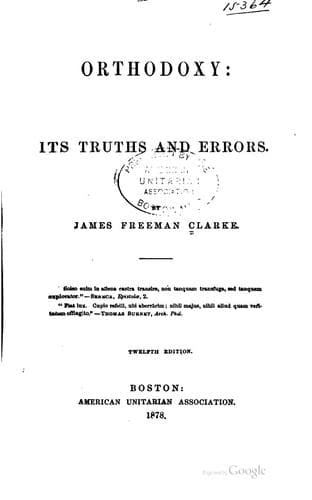
Orthodoxy: Its Truths And ErrorsClarke, James Freeman
Religion
Orthodoxy: Its Truths And Errors
Clarke, James Freeman
Unitarianism
What I understand Jesus, then, to teach in this passage, is, that we must
become as little children, in order to see heavenly things; that, like
new-born babes, we must receive meekly the milk of the word of God; that
spiritual influences are all around us, invisible—incalculable: that not
by the regular outward means of religion alone, but by a thousand other
ways, God comes to us. He means that we should believe in the presence and
nearness of God’s Spirit always; that we should open our hearts and minds
to be led by it into truth and love. He meant the very opposite of what he
has been made to mean. He did not mean that all souls must pass through
one and the same religions experience, but that, as the wind blows a
thousand ways, so God’s Spirit comes to the heart by a thousand ways. So
coming, it makes the hard heart tender, the rude will gentle, the selfish
soul generous, gives the reckless a new sense of responsibility. Jesus
means that we should not be discouraged because we find it hard to correct
our faults, or to enter into God’s love. God’s Spirit comes to us when we
cannot go to find it. God’s love comes into our hearts when we long for
it, look for it, wait for it.
Look up, then, poor trembling heart; look up, and see God near. Look up,
hard heart, and feel the soft showers of divine grace coming down to make
everything tender. Look up, and be made new creatures, become as little
children, be born anew, every day, into a fresh inspiration, faith, and
hope; and so enter every day the kingdom of heaven!
§ 12. Evidences of Regeneration.
The common Orthodox method is to require and expect evidence of the
Christian change. As we have already said, a Christian is expected to know
and to be able to tell when, where, and under what circumstances he
entered into the new life.
But, perhaps, the preliminary question is, Ought we to have, and can we
have, any evidence at all of the new life? And to this question many reply
in the negative, and with very good reason.
The new life is a hidden life; a “life hid with Christ in God.” Its
essence is love, and love is an inward sentiment, not an outward act.
Conviction demands utterance; actions speak louder than words; but love is
accustomed to hide itself away in the heart, and to be known only to its
object, and that indirectly. _Evidences of love!_ What should we think of
asking of young people coming to be married, the evidences that they loved
each other; obliging them to give an account of their experience; to say
when, where, and how they began first to care for each other; and then, if
the evidence was satisfactory, allowing them to be married! Why, then, ask
of the soul wishing to be united with God and Christ in a Christian
covenant, to tear open the folded bud of this tender affection, analyze it
metaphysically, measure it mathematically, and cross-examine it as a
witness suspected of falsehood is questioned by lawyers before a jury?
Public-domain text, read in full here on John Shaqi.
Reviews
Reviews
No reviews yet
Be the first to share your thoughts on this work.
Elsewhere in the archive
Join the Discussion
Join the discussion
Sign in to leave a comment or review.
Sign InorCreate an account