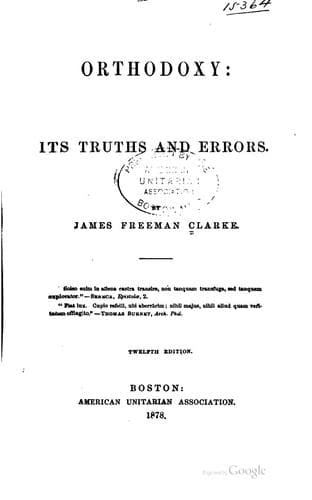
Orthodoxy: Its Truths And ErrorsClarke, James Freeman
Religion
Orthodoxy: Its Truths And Errors
Clarke, James Freeman
Unitarianism
What do we know of this new life? what can we tell of it? Almost always it
comes to us gradually and unconsciously. It is veiled in shadows, misty
lights, and neutral tints. The second life comes like the first. The child
is born, and knows not of the awful change from not being to being—the
immense event of passage from unconscious existence to conscious life. For
consciousness dawns slowly, imperceptibly. The infant is long immersed in
outward things. Years pass before it becomes aware of the fact that it
exists, before it begins to look in and see itself in the mirror of
reflection. So, probably, will it also be, when we pass from this life
into the next. We shall, perhaps, awaken very gradually, in the future
life, to the knowledge that we are in another state. As the little child
becomes quite at home in this world before he thinks to ask how he came
here, so probably in the other world we shall become quite at home with
the angels, before we shall begin to say, “I am in heaven.”
All the births of time partake of this quality. They do not reflect on
themselves, are not surprised at themselves, but come as a matter of
course. Years after, when the early heat of the new life has grown cold,
the historians and biographers arrive to examine it in the crucible of
their painful analysis, and to tell us how wonderful it is.
How can any man _prove that he is alive_? Why _should_ he prove it? Let
his life show itself, but not try to prove itself. Let its light shine,
and those who see its good and joy will glorify the Father in heaven who
has sent it.
The mistake here, as before, is in confounding conversion and
regeneration.
Including in the terms “conversion” and “repentance” the whole activity of
the will, the religious purpose, the aim of life, it is, no doubt, of the
utmost importance to see, continually, what it is. “Know thyself” is a
heaven-descended maxim, if we understand by it that we are to watch
ourselves always, and see whither we are going. We need continually to
know the direction of our life, whether it is _to_ God or _from_ him;
whether it is upward or downward; whether we are following truth, and
justice, and love, or following our own selfish desires and will. In this
sense self-examination is both possible and necessary.
When the great ocean steamer is in the midst of the mighty Atlantic, it is
necessary to watch continually its direction, and keep it always heading
the right way. Day and night, therefore, the man stands sleepless at the
helm, his eye always turning from the compass to the ship’s head, with
unfailing vigilance. But it is not thought necessary to inspect the
interior of the boilers, or to examine the quality of the fire. If steam
enough is made, and the wheels revolve, that is enough.
Public-domain text, read in full here on John Shaqi.
Reviews
Reviews
No reviews yet
Be the first to share your thoughts on this work.
Elsewhere in the archive
Join the Discussion
Join the discussion
Sign in to leave a comment or review.
Sign InorCreate an account