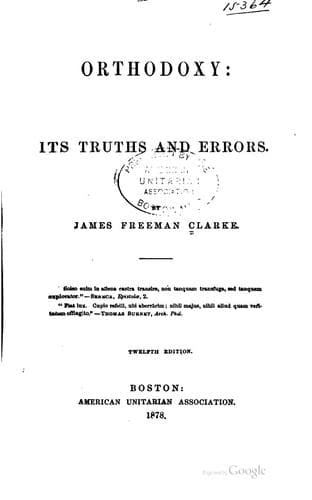
Orthodoxy: Its Truths And ErrorsClarke, James Freeman
Religion
Orthodoxy: Its Truths And Errors
Clarke, James Freeman
Unitarianism
The new life into which we enter by the new birth has this one
character—that it gives us for a motive, not fear, but hope; not law, but
love; not constraint, but joy. Prayer is not a duty, but the spontaneous
impulse of the child, to seek and find its father. Work is not drudgery
but satisfaction, when the motive is to serve the great cause of Christ.
The only real evidence, therefore, that we are born of God, is, that we
have the fruits of the Spirit, love, joy, and peace. The tree is known by
its fruits, and these are the appropriate fruits of the new life. When we
find them, let us gladly receive them; but if we do not find them, let us
at least be glad that if not yet new-born, we are, nevertheless,
converted; if not sons, at least servants. We have the one thing needful
when we have the right purpose; sooner or later, we shall also have the
happy life. When we do right, we sow to the Spirit, and we shall, in due
season, reap life everlasting.
As regards the evidence of the new life, too much stress, we think, has
been laid on outward profession, ceremonies, religious language, religious
acts. Because a man professes religion, it is no evidence that he is
religious. Because he partakes of the Lord’s supper, or prays openly, or
speaks in the habitual religious language of his sect, it is no evidence
of his religious life. Many persons are quite comforted if one who has led
an immoral life says on his death-bed that he “trusts in the atoning blood
of Christ.” But this may be a mere word.
All ceremonies and prayers are means, but none of them are evidence, of a
state. The only evidences are the fruits of the Spirit. “The tree is known
by its fruits.” “The fruits of the Spirit are love, joy, peace,
long-suffering, gentleness, goodness, faith, meekness, temperance.”
Let us remember that though a man may be converted, and not as yet be
regenerate, he cannot be regenerate unless he is converted; that is, there
can be no true piety, no love, no faith, no spiritual religion, except
there be a sincere and determined purpose of righteousness beneath it.
There may be true morality without piety, but there cannot be a true piety
without a true morality. The law must precede the gospel.
Conscientiousness must go before love, to prepare its way. “That is not
first which is spiritual, but that which is natural, and _afterwards_ that
which is spiritual.”
The _first_ question, therefore, to ask ourselves, is not, “Do I love
God?” but, “Do I obey God?” Every man’s own soul, if sincere, can answer
that question. “If our heart condemn us, God is greater than our heart.”
“If our heart condemn us not, then have we confidence towards God.”
But if we are obeying God, then let us believe in a higher life which God
has to bestow, and believing, seek for it. It is not earned, it is not a
reward, it is not by works; but it is very nigh and close at hand; it is
ready to be given to those who believe in it and look for it.
Public-domain text, read in full here on John Shaqi.
Reviews
Reviews
No reviews yet
Be the first to share your thoughts on this work.
Elsewhere in the archive
Join the Discussion
Join the discussion
Sign in to leave a comment or review.
Sign InorCreate an account