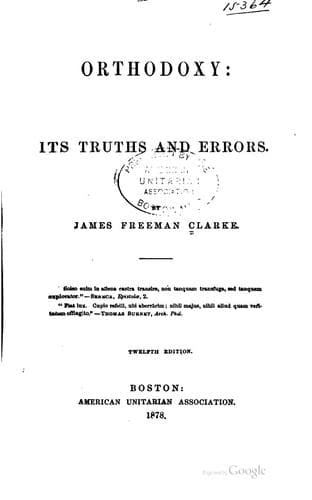
Orthodoxy: Its Truths And ErrorsClarke, James Freeman
Religion
Orthodoxy: Its Truths And Errors
Clarke, James Freeman
Unitarianism
So, if the question be asked, “Is man active or passive in this process?”
the answer is, that he is active in conversion, receptive in regeneration.
So in regard to faith and works. “We are justified by faith;” but
justification is the sense of God’s forgiving love which is received into
an open heart. Justification is not salvation; it is only a step in that
direction, and a preparation for it.
And now we ask, “Why is it, if this new life is a gift, do not all good
men receive it?” The answer is, “There are conditions. All good men do not
believe in it. Some believe that duty is every thing; that Christianity
consists _wholly_ in obedience. They know nothing higher, and therefore
seek for nothing higher. Regeneration they hear of, but think it something
mystical, miraculous, unnatural, and, to say the truth, not very
attractive. If they believed in a life of love and trust, a life free from
the burden of anxiety, they would surely desire it.”
Those also who believe in it do not always believe it is for themselves.
They think it not meant for common people in the midst of common life, but
for some special saintship. They do not believe in this divine life
flowing into every heart and soul, high and low, wise and ignorant, be it
only sincere, honest, and believing.
Yet it is like the life of nature, which in the abounding spring-time
comes down from the skies, and flows not only into the majestic tree,
swelling at once its myriad buds, but also into every seed, and root, and
weed, awakening them all.
This is what we need for peace, for real progress, for present comfort,
for future joy.
It is communion with God, it is receiving his love, it is accepting his
forgiveness, and living day by day as his beloved children.
CHAPTER VIII. THE ORTHODOX IDEA OF THE SON OF GOD.
§ 1. Orthodox Doctrine stated.
Having considered the Orthodox idea of man in his natural state, and of
man in his supernatural state, we next pass to consider the Orthodox idea
of Christ’s person and of Christ’s work. In this chapter we shall consider
the Orthodox view of the person of Christ, and ask what is its substantial
truth, and what its formal error.
The Orthodox opinion concerning Christ is thus stated in the Assembly’s
Confession of Faith: “The Son of God, the second person in the Trinity,
being very and eternal God, of one substance and equal with the Father,
did, when the fulness of time was come, take upon him man’s nature, with
all the essential properties and common infirmities thereof, yet without
sin; so that two whole, perfect, and distinct natures—the Godhead and the
Manhood—were inseparably joined together in one person, which person is
very God and very Man.”
Public-domain text, read in full here on John Shaqi.
Reviews
Reviews
No reviews yet
Be the first to share your thoughts on this work.
Elsewhere in the archive
Join the Discussion
Join the discussion
Sign in to leave a comment or review.
Sign InorCreate an account