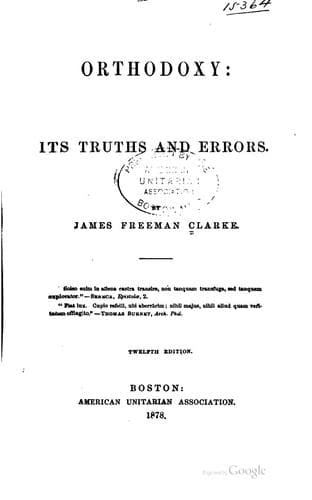
Orthodoxy: Its Truths And ErrorsClarke, James Freeman
Religion
Orthodoxy: Its Truths And Errors
Clarke, James Freeman
Unitarianism
Christ, therefore, was perfectly God and perfectly man. The formula is,
“_two natures, but one person_.” The Orthodox doctrine is not of God
dwelling in a human body as its soul (which seems to be the view of
Swedenborg), but it is of God united with a human soul and body as one
person or one consciousness.
§ 2. This Doctrine gradually developed.
This idea of Christ, as we know, was gradually formed in the Christian
Church, and did not become Orthodox until after many struggles. First came
the question whether the Deity of Christ was equal or subordinate to that
of the Father. Hardly had the Orthodox doctrine triumphed over that of
subordination, against those who denied the equal Deity, than it was
obliged to turn round and contend against those on the other side, who
denied the humanity of Christ altogether. The Ebionites considered Jesus
as a mere man. Theodotus, in the year 200, taught the same, with Artemon
and Praxeas. In the next century the Arians and Sabellians opposed
Orthodoxy from opposite sides,—the one confounding the persons of the
Godhead, and the other dividing the substance. So for several centuries
the pendulum of opinion swung from one side to the other before it rested
in the golden mean of Orthodoxy.
The Nestorians separated the two natures of Christ, and maintained that
his Divinity consisted only in the indwelling of God. But scarcely had
Nestorius been banished for separating the two natures than Eutyches
plunged into heresy on the other side, by confounding them together. This
was the Monophysite heresy; and no sooner was this overthrown, and it was
decided to be wrong to say that Christ had only one nature, than others
began to contend that he had only one will. These were the Monothelites.
But through all these controversies, the main doctrine of Orthodoxy
continues to shine out luminous and distinct, asserting that Christ
combines the fulness of Deity and the fulness of Humanity.
§ 3. Unitarian Objections.
Public-domain text, read in full here on John Shaqi.
Reviews
Reviews
No reviews yet
Be the first to share your thoughts on this work.
Elsewhere in the archive
Join the Discussion
Join the discussion
Sign in to leave a comment or review.
Sign InorCreate an account