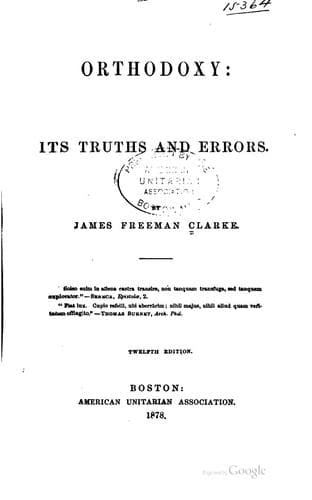
Orthodoxy: Its Truths And ErrorsClarke, James Freeman
Religion
Orthodoxy: Its Truths And Errors
Clarke, James Freeman
Unitarianism
As this view of the Deity of Christ has been stated, it seems, in its
doctrinal form, contradictory to Scripture as well as to reason. That the
infinite God, who fills the universe, and sustains it; present in the
smallest insect; present in the most distant nebula, whose light just
arriving at our eye has been a million of years on its journey,—that this
infinite Being should have been born in Palestine, seems to confute itself
by its very statement. Who took care of the universe when God was an
infant in the arms of the Virgin Mary? Jesus was born, and died; but God
cannot be born, and cannot die. Jesus suffered from hunger, fatigue, and
pain; but God cannot suffer. Jesus was seen by human eyes, and touched by
human hands; but no man hath seen God at any time. Jesus had a finite
body; but God is Spirit. Jesus was tempted; but God cannot be tempted with
evil. Jesus prayed; but God cannot pray. Jesus said, “My Father is greater
than I;” but God has no one greater than himself. Jesus said, “I can of
mine own self do nothing;” but God can of his own self do everything.
Jesus said “that he came down from heaven not to do his own will;” but God
always does his own will. Jesus said that there were some things he did
not know; but God knows everything. He declared that all power was _given_
to him in heaven and earth; but God’s power cannot be given to him.
Scripture, therefore, as well as common sense, seems to deny the Orthodox
doctrine of the Deity of Christ.
The common Trinitarian answer to these texts is, that Christ is speaking
in his human nature when he asserts these limitations. But this answer, as
Dr. Bushnell has well shown, is no answer; for, as he says, “it not only
does an affront to the plain language of Scripture, but virtually denies
any real unity between the human and the divine.” Jesus does not say, “All
power in heaven and earth is given _to my human nature_,” but “to _me_;”
and when the Trinitarian himself declares that in Christ, with two
natures, there is but _one person_, the question is concerning that one
person, whether _that_ is finite or infinite, absolute or dependent,
omniscient or not so, omnipresent or not so, omnipotent or not so. The
question does not concern his nature, but himself. The one person must be
either finite or infinite: it cannot be both.
§ 4. Substantial Truth in this Doctrine.
Public-domain text, read in full here on John Shaqi.
Reviews
Reviews
No reviews yet
Be the first to share your thoughts on this work.
Elsewhere in the archive
Join the Discussion
Join the discussion
Sign in to leave a comment or review.
Sign InorCreate an account