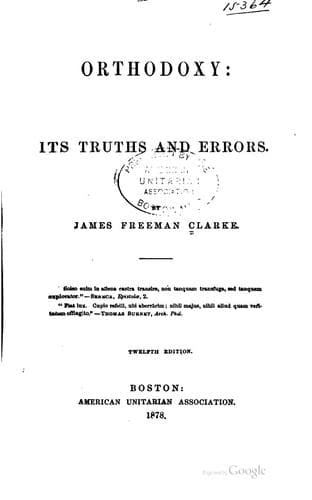
Orthodoxy: Its Truths And ErrorsClarke, James Freeman
Religion
Orthodoxy: Its Truths And Errors
Clarke, James Freeman
Unitarianism
But now we ask, What substantial truth underlies this formal error? What
truth of life underlies this error of doctrine? Let us remember how empty
the world was of God at the time of Christ’s coming. The wisest men could
speak thus with Pliny: “All religion is the offspring of necessity,
weakness, and fear. What God is,—if in truth he be anything distinct from
the world,—it is beyond the power of man’s understanding to know.” All
intelligent men agreed that if God existed he could not possibly take any
interest in the affairs of the world or of individuals. Phariseeism on the
one hand, and Sadduceeism on the other,—a religion hardened into forms,
and an empty scepticism, cold and dead,—divided the world between them.
But men cannot live without God, and be satisfied. They were feeling after
him, if haply they might find him, who is not far from any one of us.
Then Christ came; and in all that he said and did, he spoke from the
knowledge of God; he acted from the life of God. Here was one, then, at
last, to whom God was not an opinion, but a reality; through whose life
flowed the life of God in a steady current. We see that all sincere souls
who came near Jesus received from him the same sight of God which he
possessed; for faith in a living and present God is so congenial to the
nature of man, that it carries conviction with it wherever it is not a
mere opinion, but a state of the soul.
Those, therefore, who could find God nowhere else, found him in Christ.
Those who saw _him_, saw the Father. As when through a window we behold
the heavens, as when in a mirror we see an image of the sun, we do not
speak of the window or the mirror, but say that we see the sun and the
heavens, so those who looked at Christ said that they saw God.
The apostle said that God was in Christ; and this was wholly true.
Christians afterwards said that Christ was God; and they thought they were
only saying the same thing. They said that Christ had a divine nature as
well as a human nature; and in this also there was no essential falsehood,
for when we speak of our nature, we intend merely by it those elements of
character which are original and permanent, which are not acquired, do not
alter, and are never lost. God dwelt in the soul of Christ thus
constantly, thus permanently. The Word thus “became flesh, and dwelt among
us.” The word of the Lord _came_ to the prophets, but it _dwelt_ in
Christ. He and his Father were one. The vital truth of all this was that
men were now able to see God manifested in man as a living, present
reality. “_Here_,” they said, “is God. We have found God. He is in Christ.
We can see him there.”
Public-domain text, read in full here on John Shaqi.
Reviews
Reviews
No reviews yet
Be the first to share your thoughts on this work.
Elsewhere in the archive
Join the Discussion
Join the discussion
Sign in to leave a comment or review.
Sign InorCreate an account