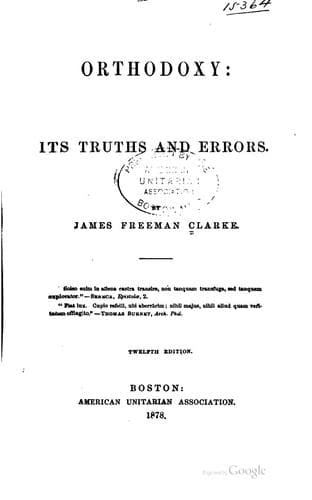
Orthodoxy: Its Truths And ErrorsClarke, James Freeman
Religion
Orthodoxy: Its Truths And Errors
Clarke, James Freeman
Unitarianism
Is it any wonder that men should have called Jesus God? that they should
call him so still? In him truly “dwelt the fulness of the Godhead bodily;”
and this indwelling Spirit expressed itself in what he said and what he
did. When Jesus speaks, it is as if God speaks. When Jesus does anything,
it is as if we saw God do it. It becomes to us an expression of the divine
character. When Jesus says to the sinner, “Go and sin no more,” we see in
this a manifestation not merely of his own compassion, but of God’s
forgiving love; and when he dies, although God cannot die, yet he dies
according to the divine will, and thus expresses God’s willingness to
suffer for the redemption of the world.
§ 5. Formal Error of the Orthodox Statement.
When we look at Christ’s Divinity from this point of view, the distinction
between the Trinitarian and Unitarian seems almost to disappear. Still the
question remains, Is it right to call him God? The distinction remains
between saying, “God was in Christ,” and saying, “Christ was God.” In
short, was the _person_ of Christ human or divine? We agree with the
Orthodox in saying that Christ had two natures—a divine nature and a human
nature. We also maintain with them that he had one person. But the
question comes, Was that one person divine or human, finite or infinite,
dependent or absolute? The consciousness of the one person is a single
consciousness. Christ could not at the same time have been conscious of
knowing all things and of not knowing all things, of having all power and
of not having it, of depending on God for all things and of not depending
for anything. One of two things alone is possible. Either Christ was God
united with a human soul, or he was a human soul united with God. When
Christ uses the personal pronoun “I,” he must mean by that “_I_” either
the finite man or the infinite God. I believe the Unitarian is right in
saying that this personal pronoun “I” always refers to the finite being
and consciousness, and not to the infinite Being. For example: “_I am not
alone, but I and the Father that sent me._” “_I proceeded forth and came
from God; neither came I of myself, but he sent me._” God cannot proceed
from God; God cannot send God. Again: “If I honor myself, my honor is
nothing; it is my Father that honoreth me.” This cannot mean, “If God
honors God, his honor is nothing; but it is God that honors him.” It must
mean that the human being, Christ, receives his honor from the divine
Being. This view—that the person of Christ is human, but is intimately
united and in perfect union with the indwelling God—makes all Scripture
intelligible. Any other view is either unintelligible or contradictory.
This view of the divine nature of Christ united with the human person, of
God dwelling in the flesh, does not confound the mind like the common
Trinitarian view, and yet has a value for the heart of paramount
importance. If Christ is really a man like ourselves, made in all respects
Public-domain text, read in full here on John Shaqi.
Reviews
Reviews
No reviews yet
Be the first to share your thoughts on this work.
Elsewhere in the archive
Join the Discussion
Join the discussion
Sign in to leave a comment or review.
Sign InorCreate an account