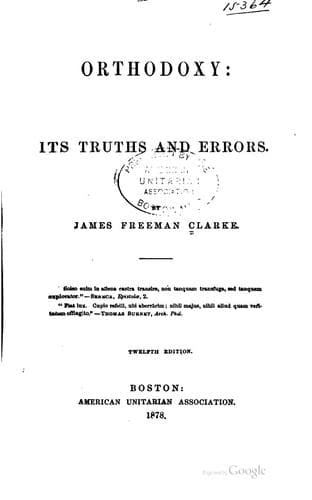
Orthodoxy: Its Truths And ErrorsClarke, James Freeman
Religion
Orthodoxy: Its Truths And Errors
Clarke, James Freeman
Unitarianism
like his brethren, and yet is thus at one with God, thus full of God, it
shows us that sin and separation from God are accidental things, and not
anything necessary. If Jesus is truly a man, he redeems and exalts
humanity. What he has been is a type of what all men may be. Thus the
apostle Paul speaks when he says that all things were created in Christ,
who is the beginning, the first-born from the dead, that he might go
before us, or be our leader in all things; which is a much higher view
than the common understanding of the passage, which merely supposes him to
have been God’s instrument in creating the physical universe. He is the
image of the invisible God—the first-born of the whole creation. This
creation is the new creation—that which is intended in Revelation (3:14),
where Christ is spoken of as the Amen, the faithful and true Witness, the
Beginning of the creation of God, and that which Paul means when he says
that in Christ Jesus neither circumcision nor uncircumcision is worth
anything, “but the new creation.”
All such passages refer, as it seems to us, not to a past natural
creation, but to a supernatural creation—a creation of life eternal,
which, beginning in Christ, is to embrace the whole of humanity.
§ 6. Errors of Arianism and Naturalism.
And we cannot but think this doctrine far truer, as well as more Orthodox,
than the Arianism which so long struggled in the Church for supremacy.
That view which supposed that Christ was neither truly man nor truly God,
but some high, preëxisting being between the two, appears to us to be the
falsest and most unsatisfactory of all the doctrines concerning Christ’s
person. It separates him more entirely from our sympathies than either of
the others. It destroys both his divinity and his humanity, and, by giving
us something intermediate, gives us really nothing. It makes his apparent
human life a delusion, his temptation unreal, his human sympathies and
sorrows deceptive. We think, therefore, that the Church was right in
rejecting the Arian doctrine.
Public-domain text, read in full here on John Shaqi.
Reviews
Reviews
No reviews yet
Be the first to share your thoughts on this work.
Elsewhere in the archive
Join the Discussion
Join the discussion
Sign in to leave a comment or review.
Sign InorCreate an account