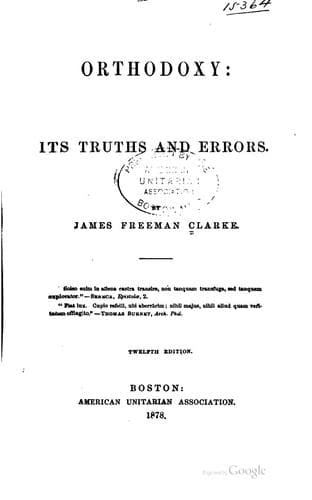
Orthodoxy: Its Truths And ErrorsClarke, James Freeman
Religion
Orthodoxy: Its Truths And Errors
Clarke, James Freeman
Unitarianism
We think it was also right in rejecting the Humanitarian doctrine, or that
of mere Naturalism. Christ was something more than mere man,—something
more than Moses and Elijah,—something more than a man of great religious
genius. The peculiarity of Christ was, that he was chosen by God’s wisdom,
and prepared by God’s providence, to be the typical man of the race,—the
God-man, in whom the divine Spirit and human soul become one in a perfect
union. He was, perhaps, placed, by an exceptional birth, where the first
Adam stood,—rescued from inherited depravity, made in the image of God.
Then the Spirit was given him without measure. The word of God _dwelt_ in
him, and did not merely come to him as a transient influence for a special
purpose. Add to this a freely chosen aim of life, and a fidelity which was
always about his Father’s business, and aiming to finish the work which
was given him to do, and we have a being in whom we can see either a
manifestation of God or a manifestation of man. The Spirit in Christ was
one with God; the soul and body were human.
CHAPTER IX. JUSTIFICATION BY FAITH.
§ 1. This Doctrine of Paul not obsolete.
That portion of the New Testament which speaks so earnestly of
justification by faith is by many supposed to have become obsolete for all
useful purposes at the present time. The doctrine that “we are justified
by faith, and not by works,” it is supposed, was intended for the benefit
of the Jews alone, and to amount to this—that admittance to the privileges
of the gospel is to be obtained, not by practising the ceremonies and
external ritual of the Jewish law, but by a simple belief in Jesus Christ.
Accordingly, as no one nowadays endeavors to become a Christian by
practising the Jewish ceremonies, we suppose that there is no present need
of this doctrine; and when we come upon it in the Scripture, we turn over
the pages in search of something more practical and profitable. As, in the
book of Acts, we read, that, “when Paul was about to open his mouth,
Gallio said unto the Jews, If it were a matter of wrong or wicked
lewdness, O Jews, reason would that I should bear with you; but if it be a
question of words and names, and of your law, look ye to it; for I will be
no judge of such matters,” so we, when Paul is about to open his mouth to
speak to us of this doctrine, think it a mere question of words and names,
and of the Jewish law, and interrupt him to ask him for something
_practical_. If he has anything to say to us of wrong-doing or wicked
conduct, it would be reasonable to hear him; but we will be no judge of
such matters as this.
Public-domain text, read in full here on John Shaqi.
Reviews
Reviews
No reviews yet
Be the first to share your thoughts on this work.
Elsewhere in the archive
Join the Discussion
Join the discussion
Sign in to leave a comment or review.
Sign InorCreate an account