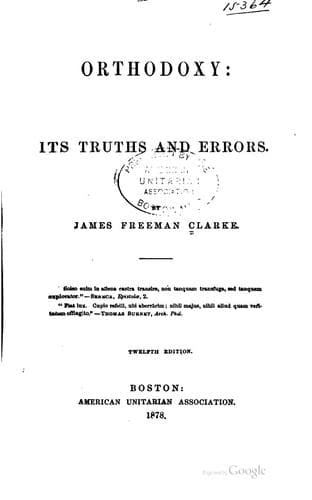
Orthodoxy: Its Truths And ErrorsClarke, James Freeman
Religion
Orthodoxy: Its Truths And Errors
Clarke, James Freeman
Unitarianism
There are also many persons, who, while they can understand the Gospels
and enjoy them, find it difficult to understand and enjoy the writings of
the apostle Paul. Among these writings, the most difficult is the Epistle
to the Romans, and especially that part of it which treats of this
doctrine of justification by faith. Anything which can be done to remove
this difficulty will do good; for the writings of Paul are so intimately
connected with the rest of the New Testament, that it is not easy to
reject them, and yet to believe the rest. It can be done, no doubt; but it
is done with difficulty. It is as if one part of the foundation of the
house had given way: perhaps the house will not fall; but it has become
unsafe. It is as if a part of the wall of a city had been battered down:
the breach may be defensible from within; but it is also practicable from
without. At all events, we miss the satisfaction of a complete faith,
perfect and entire, round and full.
Besides, may there not be something important for us to know in this part
of the New Testament? Are we quite sure we do not need these very
doctrines, and that they will do us good?
We have said that it is sometimes thought that the questions discussed by
Paul were only Jewish questions,—not human questions; that they belonged
only to that time, not to all time. But, though the form which they
assumed was temporary and local, there is reason to believe that the
substance of the question is one belonging to human nature in every age;
that it is the question of the spirit and the letter, the substance and
the form, the root and the branches, the inside of religion and the
outside. While contending against a particular Jewish error, the apostle
unfolded principles by which similar errors may be opposed and refuted in
every age.
At all events, it is a matter of fact, that there seldom has been in the
Church any great religious movement which has not immediately gone back to
the apostle Paul, and planted itself on his doctrine of justification by
faith. This was the watchword of Luther, and the soul of the reformation.
Luther and his companions armed themselves with this doctrine to contend
against the great power of the Papacy and the Romish Church.
Let us, then, endeavor to see what we can of the truth there may be in
this doctrine.
§ 2. Its Meaning and Importance.
And, first, let us see what the doctrine does not mean, and what it does
mean.
Public-domain text, read in full here on John Shaqi.
Reviews
Reviews
No reviews yet
Be the first to share your thoughts on this work.
Elsewhere in the archive
Join the Discussion
Join the discussion
Sign in to leave a comment or review.
Sign InorCreate an account