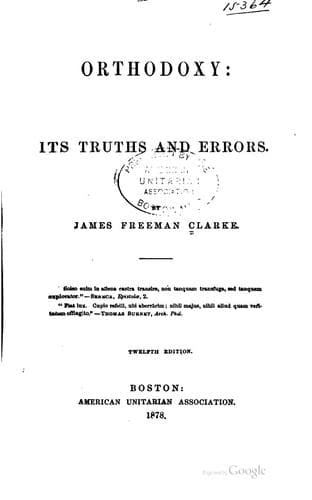
Orthodoxy: Its Truths And ErrorsClarke, James Freeman
Religion
Orthodoxy: Its Truths And Errors
Clarke, James Freeman
Unitarianism
To be justified by faith does not mean that we are to be saved by our
opinions. To say that a man can be saved by holding certain opinions,
instead of certain other opinions, is to say what is contradicted by all
experience; for experience shows us that there are good men holding every
variety of opinion, and bad men holding every variety of opinion. But God
saves men by making them good: therefore men are not saved by their
opinions. Let us suppose that men are to be saved by the opinion that
Jesus is the Christ: then we ought to find that all men holding that
opinion are on the way of salvation; that is, are becoming good men. But
this is far from being the case. In fact, the connection between mere
opinion of any kind, and goodness, is very distant and indirect. No doubt,
in the long run, opinion affects character; but it is only in the long run
that it does so. And, at all events, the doctrine of the New Testament is
very distinct and decided, that men may hold very sound opinions, and yet
not be in the way of salvation. The Scribes and Pharisees held very sound
opinions; and Jesus told his disciples to do whatever they said, but not
to imitate their works; for their doctrine was much better than their
lives.
Nor does the apostle mean to say that one can be saved without morality.
He certainly does not mean to undervalue goodness; for, in that case, he
would contradict his own teachings, which uniformly declare, as all the
rest of the Bible declares, that without holiness no man can see the Lord.
It is certainly a very superficial view which is satisfied with supposing
that an earnest man, as the apostle certainly was, devoting his life, as
he certainly did, to the teaching of Christianity, with such a grand
intellect as he certainly possessed, could assert with so much energy a
doctrine plainly contradicting common sense, daily observation, the plain
teachings of Jesus, and his own uniform doctrine elsewhere.
Some persons have a short method of getting over the difficulty by saying
that Paul did not himself know what he meant. They assume that he was
talking at random. It would be about as wise, when we open Newton’s
“Principia,” and cannot understand it, to say that Newton was talking at
random; or, when we cannot understand Plato or some other profound
metaphysician, to declare directly that he did not himself know what he
was talking about. No doubt, this is the shortest and easiest way of
getting out of such difficulties, but perhaps not the most modest, nor the
most wise.
When an earnest man, a profound man, a man in the highest degree
practical, a man who has done the greatest work for Christianity which has
been done since its foundation, sums up his doctrine in a comprehensive
maxim like this, it is, perhaps, wise to admit, at once, that he had a
meaning, and probably an important one.
Public-domain text, read in full here on John Shaqi.
Reviews
Reviews
No reviews yet
Be the first to share your thoughts on this work.
Elsewhere in the archive
Join the Discussion
Join the discussion
Sign in to leave a comment or review.
Sign InorCreate an account