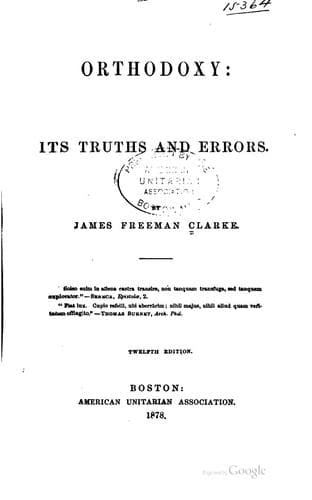
Orthodoxy: Its Truths And ErrorsClarke, James Freeman
Religion
Orthodoxy: Its Truths And Errors
Clarke, James Freeman
Unitarianism
“No doubt he _had_ a meaning,” it may be said; “but has he any meaning
_now_? His formula meant something for the Jews; but does it mean anything
for us? Is not this merely a Jewish question, with which we have nothing
to do?”
This is another easy way of getting over difficulties. In reading the New
Testament, when we come to a place where we are stopped by something which
looks deep and is dark, we are often told, “That darkness is not depth: it
is the shadow of a Jewish error which lies across the path.”
Have we not often felt dissatisfied, when, approaching some great saying
of Christ and his apostles from which we hoped to gain new insight, we
have been told, “That has nothing to do with _us_. The Jews had such and
such an opinion, and this was meant to show them their mistake”? So the
great and earnest words of the Bible, which we thought to be full of
spirit and life, are found to be only fossil remains of old opinions, of
opinions long since passed away—good for nothing but to be put into the
museums of antiquaries, and paraded by scholastic pedants.
But, after all, take it on the lowest ground, were not the Jews men? Did
they not, as a race, represent some element, common, in a less degree, to
the rest of mankind? and therefore is there not in each of us something of
that Jewish element? Are not we also sometimes Jews, therefore liable to
Jewish errors, and needing to have them corrected? The Jews did not live
in vain: their struggles, errors, hopes, were for the benefit of humanity.
We were to learn something by their mistakes, and to be taught something
by their experience.
Another way of treating such a passage is to translate it into some
trivial, insignificant commonplace. Thus, we are told, our doctrine only
means that “_God does not approve a man merely for going through a routine
of outward, formal ceremonies, but for a thoroughly religious life._” This
explanation assumes that the apostle is here talking to simpletons, and
that what he says is no more worth listening to by us than the prattle of
a nurse to her infant.
There are, therefore, four ways of explaining this passage, none of which
are satisfactory. These are, that Paul,—
1. Was teaching a self-evident absurdity;
2. Was teaching a self-evident truism;
3. Was teaching nothing, and only talking at random;
4. Was correcting a Jewish error, which only the Jews ever had, or are
ever likely to have.
If these views are not satisfactory to us, the simplest way would seem to
be, first, to endeavor to understand precisely what the Jewish error was,
and then to see if there is anything like it in ourselves, and if there be
anything which we can learn from this old argument which will be, not old,
but new for our time and for all time, because a part of the tendencies of
man. Let us translate these old terms—_justification_, _faith_,
_works_—into their modern equivalents, and see what they mean for us at
the present time.
Public-domain text, read in full here on John Shaqi.
Reviews
Reviews
No reviews yet
Be the first to share your thoughts on this work.
Elsewhere in the archive
Join the Discussion
Join the discussion
Sign in to leave a comment or review.
Sign InorCreate an account