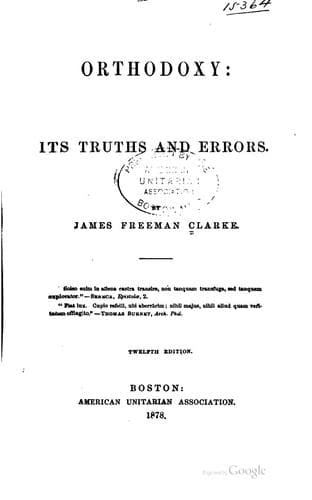
Orthodoxy: Its Truths And ErrorsClarke, James Freeman
Religion
Orthodoxy: Its Truths And Errors
Clarke, James Freeman
Unitarianism
Sin is our conqueror, and Christ redeems us. Sin is a slavery, and Christ
ransoms us. Sin is defilement, and Christ washes us. Sin is a disease, and
Christ heals us. All this occurs again and again, but nothing occurs about
constitutional governments, or conflicts between the claims of justice and
mercy.
§ 6. The three principal Views of the Atonement—warlike, legal, and
governmental.
Three principal views on this subject have prevailed in the Christian
Church as Orthodox. The first may be called the _warlike_ view of Christ’s
work, the second may be called the _legal_ view, and the third the
_governmental_ view. The first was the prevailing Orthodox view from the
earliest times till the middle ages, and is based on the idea of a
conflict or war between Christ and the Devil for the soul of man. The
Devil had gained possession of the human race in consequence of its sin.
The right of the Devil over men was fully admitted. Augustine considered
it as the right of property, Leo the Great as the right of a conqueror.
Christ gave his own life to the Devil as a ransom, which was adequate to
redeem the whole race. This theory rested on the literal interpretation of
the words “ransom” and “redemption.” If Christ’s death was a _ransom_, if
he came “to give his life a ransom for many,” the question naturally
arose, “_From_ whose power were men redeemed, and to whom was the ransom
paid?” Certainly, men were not redeemed from the power of God. The ransom
could not have been paid to God, but to some enemy who held us as his
prisoners. The only possible answer, therefore, is, that the ransom was
paid to the Devil. The Devil was the cruel tyrant who had enslaved us. He
had a right to do so; for we had become his slaves through our sin. But he
had no right over Christ, for Christ had committed no sin; so that the
death of Christ was a free offering to the Devil to redeem the race.
According to this view, therefore, the atonement was made to the Devil.
But in the middle ages another view of the atonement became Orthodox,
founded not upon the idea of a ransom, but on that of a _debt_. According
to this view the divine law requires that the debt which man owes to God,
which is perfect obedience, shall be paid, either by himself or by some
one else. Anselm, the founder of this theory, defined sin “as not giving
to God his due.” Man cannot pay this debt himself, and therefore Christ
pays it for him. This is the legal view of the atonement, or perhaps we
might rather call it the commercial view.
Public-domain text, read in full here on John Shaqi.
Reviews
Reviews
No reviews yet
Be the first to share your thoughts on this work.
Elsewhere in the archive
Join the Discussion
Join the discussion
Sign in to leave a comment or review.
Sign InorCreate an account