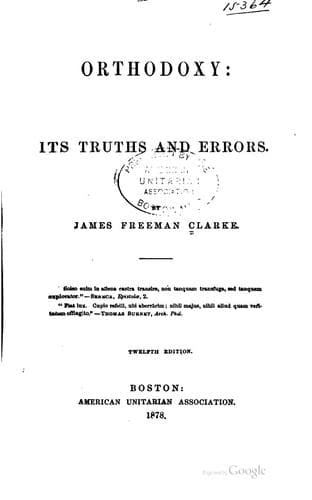
Orthodoxy: Its Truths And ErrorsClarke, James Freeman
Religion
Orthodoxy: Its Truths And Errors
Clarke, James Freeman
Unitarianism
But this theory, after having endured as Orthodox for some five hundred
years, gave place to a third, based not on the idea of a ransom or of a
debt, but of a state necessity. It would not do for God, as a moral
Governor, to forgive sin, unless by some great example an impression could
be made of the evil of sin. This impression is produced by the death of
Christ, who therefore died not to atone for past sin, but to prevent
future sin, or, in other words, to make a moral impression on the human
mind. This is the popular theory of the atonement held by the Orthodox at
the present time. But it is very much mixed up with the others. The
different views held by modern Orthodoxy range all the way from the old
Calvinism of Princeton, through the various shades of New England
theology, to the latest form expressed by Dr. Horace Bushnell in his
recent work on “Vicarious Sacrifice.”
§ 7. Impression made by Christ’s Death on the Minds of his Disciples.
First Theory on the Subject in the Epistle to the Hebrews.
The sufferings of Jesus produced a wonderful impression on the minds of
his disciples. This impression was compounded of astonishment, tenderness,
and gratitude. That a man so divine in character, in wisdom, in a command
over nature, should submit willingly to such labor, ignominy, and anguish,
was a wonder to them. But there was a mystery of sorrow beneath the
visible sorrow, a pain within the pain, a depth of grief felt not for
himself, but for others, an anguish on account of the sin of the world,
which especially awed and touched them. Christ plunged into the midst of
sin to save souls, as a hero rushes into the midst of burning flames to
save lives. No man like Jesus had ever felt such anguish and horror at the
sight of sin; but instead of flying from it, he came into the midst of it
to save the sinner. This was the secret of his agony, the bitterness of
his cup. Martyrs at the stake are borne up by their own triumphant
self-approval. But Jesus, in his anguish, did not think of his own
triumph, but the sin and sorrow of those who afflicted him. “Daughters of
Jerusalem, weep not for me, but weep for yourselves and your children.”
“Father, forgive them; they know not what they do.” This is the secret of
Christ’s anguish—this infinite horror of sin joined to an infinite love
for the sinner.
Through this depth of sorrow there came to the minds of the apostles a
revelation of the evil of sin and the infinite compassion of God, which
produced penitence, hope, and love. The dying Christ reconciled them to
God. This they felt and declared; they did not attempt to explain how, but
by images and metaphors drawn from all familiar objects, they declared
that Christ’s sorrows more than his glory, his patience rather than his
power, his death more than his life, had withdrawn their hearts from sin,
and given them peace with God.
Public-domain text, read in full here on John Shaqi.
Reviews
Reviews
No reviews yet
Be the first to share your thoughts on this work.
Elsewhere in the archive
Join the Discussion
Join the discussion
Sign in to leave a comment or review.
Sign InorCreate an account