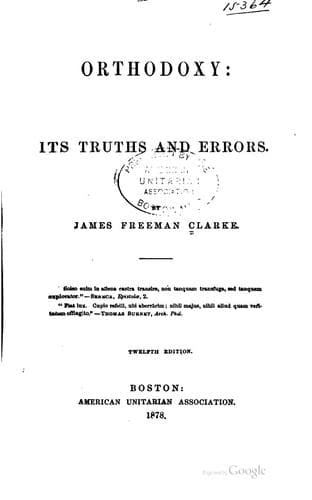
Orthodoxy: Its Truths And ErrorsClarke, James Freeman
Religion
Orthodoxy: Its Truths And Errors
Clarke, James Freeman
Unitarianism
One writer alone in the New Testament attempts an explanation of this
influence. It is only an attempt, a mere hint, the germ of a theology: it
is found in the Epistle to the Hebrews.(20)
According to these passages Christ suffered,—1. To learn obedience; 2.
That he might thus become perfect; 3. By an entire cultivation of his
sympathies with the tempted; 4. So as to become to them the author of
eternal salvation by reconciling them to God.
This, we may observe, so far as it goes, is really a theory of atonement,
and not a mere statement of the fact. Moreover, it seems to us to contain
the germ of a far nobler and deeper theory than any in which the Church
has hitherto believed. It is more human, more rational, connected more
with real experience and the solid facts of life.
§ 8. Value of Suffering as a Means of Education.
The sufferings of Christ were necessary for his own perfection, and
suffering in some form or other is necessary for all perfection. It is
often said that suffering in this world is casual, an accidental thing,
arising from human mistakes, and that the time will come in which man will
grow up into perfection without suffering. A perpetual sunlight is thought
to be the best condition for the human plant. Pain and want stunt its
growth, winter storms arrest its development; and so it is supposed that
if we can get rid of this element of suffering, human beings will soon
become all they ought to be. But the poet speaks more wisely who says,—
“To each their sufferings: all are men
Condemned alike to groan;
The feeling for another’s woe,
The unfeeling for his own.”
For suppose that we could remove from the world all outward evil—get rid
of sickness, pain, poverty, death. Would not the worst part of evil still
remain? Would not discontent, selfishness, envy, wilfulness, cruelty,
self-indulgence continue? All these exist—perhaps exist most
frequently—where there is the least of outward evil; and the outward evil
is the bitter medicine which comes by and by as a cure.
§ 9. The Human Conscience suggests the Need of some Satisfaction in order
to our Forgiveness.
Public-domain text, read in full here on John Shaqi.
Reviews
Reviews
No reviews yet
Be the first to share your thoughts on this work.
Elsewhere in the archive
Join the Discussion
Join the discussion
Sign in to leave a comment or review.
Sign InorCreate an account