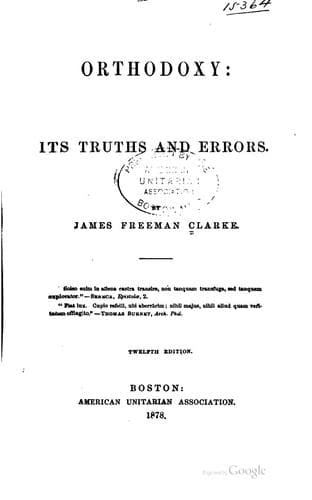
Orthodoxy: Its Truths And ErrorsClarke, James Freeman
Religion
Orthodoxy: Its Truths And Errors
Clarke, James Freeman
Unitarianism
THE METAPHYSICAL PROOF.—This is based on the distinction of soul and body.
The existence of the soul is proved exactly as we prove the existence of
the body. If we can prove the one, we can equally prove the other. If any
one asks, How do we know there is such a thing as body? we reply that we
know it by the senses; we can touch, taste, smell, and see it. But to this
the answer is, that the senses only give us sensations, and that these
sensations are in the mind, not out of it. We have a sensation of
resistance, of color, of perfume, and the like; but how do we know that
there is anything outside of the mind corresponding to them? The answer to
this is, that by a necessary law of the reason, when we have a sensation,
we _infer_ some external substance from which it proceeds. We look at a
book, for example. We have a sensation of shape and color; we infer
something outside of our mind from which it proceeds. In other words, we
perceive qualities and infer substance. This inference is a spontaneous
and inevitable act of the mind. Now, we are conscious of another group of
feelings which are not sensations, which do not come from without, but
from within. These are mental and moral. But they, too, are qualities;
and, as in the other case, perceiving qualities, we infer a substance in
which they inhere. This latter substance we name soul, and we know it
exactly as we know body. It is known by us as a simple substance, having
personal unity. The personality, the “I,” is a fundamental idea. Now, as
soon as we perceive the existence of soul, it becomes evident that soul
_cannot_ die. It may be annihilated, but it cannot die. For what is
_death_ when applied to the body? Dissolution or separation of the parts,
but not destruction of the simple elements. Death is decomposition of
these elements, and their resolution into new combinations. Now, the soul,
being known by us as a simple substance, is incapable of dissolution.
This is the metaphysical proof of immortality. Then comes the TELEOLOGIC
proof, or that from final causes. Man’s end is not reached in this life.
We see everything in this world made for an end. The body is made for an
end, and attains it, and then decays and is dissolved. The soul, with all
its great powers, goes on and on, but the body dies before the soul is
ever perfected. Every human life is like an unfinished tale in a magazine,
with “to be continued” written at its close, to show that it is not yet
ended.
And besides these proofs of immortality, there is the THEOLOGICAL proof,
founded on the attributes of God; and the MORAL proof, based on the
conflict between conscience and self-love; and the ANALOGICAL proof, based
on the law of progress in nature; and the COSMIC proof, founded on the
relation of the soul to the universe; and the HISTORIC proof, resting on
the universal belief in immortality; and lastly, the PSYCHOLOGIC proof, or
the instinct of life in man, which carries with it its own evidence of
continuity.
Public-domain text, read in full here on John Shaqi.
Reviews
Reviews
No reviews yet
Be the first to share your thoughts on this work.
Elsewhere in the archive
Join the Discussion
Join the discussion
Sign in to leave a comment or review.
Sign InorCreate an account