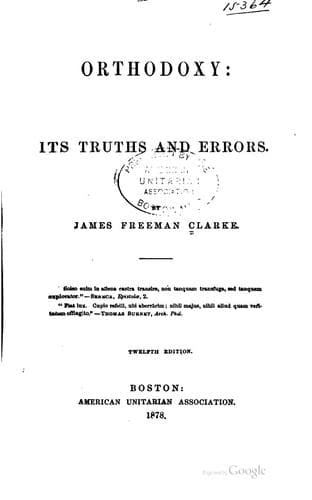
Orthodoxy: Its Truths And ErrorsClarke, James Freeman
Religion
Orthodoxy: Its Truths And Errors
Clarke, James Freeman
Unitarianism
But after all these proofs have been considered, the final result is
probability. Only the last gives more, and this acts not as an argument,
but as conviction. And the strength of this conviction depends on the
strength in any individual of this instinct. Some have more of the
instinct of life, others less.(29) Those who have much are easily
convinced by these various arguments. But those who have less, feel as
Cicero did after reading the Phædo of Plato.(30)
This instinct of life appears not only to be different from the fear of
death, but its exact opposite. When we have most of the one, we have the
least of the other. Any great excitement lifts us temporarily above the
fear of death by giving us more life. So a man will plunge into the sea,
and risk his own life to save that of another. So whole armies go to die
cheerfully in the great rage of battle. But this instinct receives a
permanent strength by all that elevates the soul. All greatness of aim,
all devotion to duty, all generous love, take away the fear of death by
adding to the quantum of life in the soul.(31)
If it be asked what the Scriptures teach concerning immortality, it must
be admitted that they have not much to say. They speak of life and of
eternal life; but this, as we shall discover, is quite another thing from
continued existence. It refers to the quality and quantity of being, and
not merely to its duration.
§ 3. The Three Principal Views of Death—the Pagan, Jewish, and Christian.
There are three principal views of death—the Pagan view, the Jewish view,
and the Christian view.
PAGANISM, in all its various forms, is chiefly distinguished by its
transferring to the other life the tastes, feelings, habits of this life.
The other world is this one, shaded off and toned down. It is gray in its
hue, wanting the color of this world; and is really inferior to it, and
only its pale reflection. To the gods of Olympus the doings of men are
matters of chief interest. Tartarus and the Elysian Fields are occupied by
lymphatic ghosts, misty spectres, unsubstantial and unoccupied. When a
living man enters, like Ulysses, Æneas, or Dante, they throng around him,
delighted to have something in which they can take a real interest.
“Better be a plough-boy on earth than a king among the ghosts.” This
expresses the Pagan idea of the other world. This world is more _real_
than the other, to the Pagan.
Public-domain text, read in full here on John Shaqi.
Reviews
Reviews
No reviews yet
Be the first to share your thoughts on this work.
Elsewhere in the archive
Join the Discussion
Join the discussion
Sign in to leave a comment or review.
Sign InorCreate an account