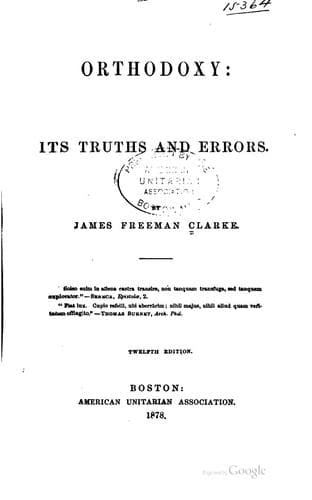
Orthodoxy: Its Truths And ErrorsClarke, James Freeman
Religion
Orthodoxy: Its Truths And Errors
Clarke, James Freeman
Unitarianism
It is evident, therefore, that our translators considered _judgment_ to be
the primary and usual meaning of the word. Why, then, did they not
translate it here, “rising to judgment,” or “resurrection of judgment”? It
must have been because they believed either that (1.) “judgment” would
make no sense here; (2.) that “damnation” would make better sense; or,
(3.) that “damnation” was more in accordance with the analogy of faith.
But we can decide these points for ourselves. “Judgment” is the better
word here, for it accords with the doctrine of the New Testament, that in
proportion as man goes wrong, he dulls his moral sense, and needs a
revelation of truth to show him what he is. A true man, who has lived
according to the truth here, has judged himself, and will not need to be
judged hereafter. (1 Cor. 11:31.) He rises into the resurrection of life.
But those who follow falsehood here, need to see the truth; and they rise
into the resurrection of judgment. The truth judges and condemns them. But
this is really an ascent to them also. It is going up higher, to see the
truth, even when it condemns them. This passage, then, is no exception to
the principle that wherever “resurrection” (ἀνάστασις) occurs in the New
Testament, it implies going up into a higher state.
All the other places where the word occurs either evidently have this
meaning, or can bear it as easily as the other. Thus (Luke 14:14), “Thou
shalt be recompensed in the higher state of the just.” (20:27), the
Sadducees “deny a higher state.” (Acts 1:21), “he is to be a witness with
us of the ascended state of Jesus.” (Acts 4:2), “preached, through Jesus,
the higher state of the dead.” (17:18), “preached to them Jesus and the
higher state.” (20:23), that Christ “should be the first to rise into the
higher state.” (Lazarus and others had returned to life again before
Jesus, so that in this sense he was _not_ the first fruits.) (Rom. 6:5),
“planted in the likeness of his resurrection.” This can only mean as
Christ passed through the grave into a higher state, so we pass through
baptism into a higher state.
Public-domain text, read in full here on John Shaqi.
Reviews
Reviews
No reviews yet
Be the first to share your thoughts on this work.
Elsewhere in the archive
Join the Discussion
Join the discussion
Sign in to leave a comment or review.
Sign InorCreate an account