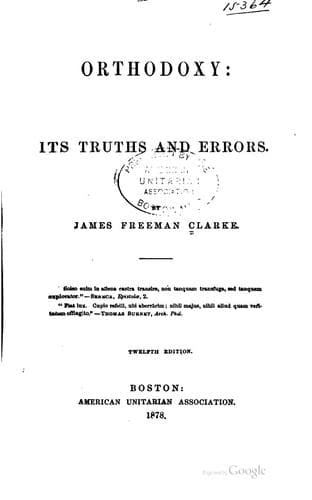
Orthodoxy: Its Truths And ErrorsClarke, James Freeman
Religion
Orthodoxy: Its Truths And Errors
Clarke, James Freeman
Unitarianism
The only text which presents any real difficulty is Heb. 11:35,
translated, “women received their dead raised to life again,” literally,
“women received from the resurrection their dead” (ἐξ ἀναστάσεως), which
may refer to a return to this life, as in the case of the child of the
widow of Sarepta (1 Kings 17:17), and of the Shunamite (2 Kings 4:17).(38)
But in the same verse, the other and “better” resurrection is spoken of,
for the sake of which these martyrs refused to return to this life. The
case referred to is probably that of the record of the seven brothers put
to death by Antiochus (2 Macc. 7:9), who refused life offered on condition
of eating swine’s flesh, and said, when dying, “The King of the world
shall raise us up, who have died for his laws, unto everlasting life” (εἰς
αἰώνιον ἀναβίωσιν ζωῆς ἀνατήσει ἡμας), literally, “to an eternal renewal
of our life.”(39) This verse shows, therefore, that though ἀνάστασις may
mean a return to this life, yet that the other sense of a higher life is
expressly contrasted with it, even here.
Our conclusion, therefore, with regard to this term ἀνάστασις, is, that
its meaning, in New Testament usage, is not “rising again,” but “rising
up,” or “ascent.”
2. Ἀνίστημι. This word is the root of the former. It is used one hundred
and twelve times in the New Testament. It is translated with _again_ (as,
“he must rise again from the dead”) fifteen times. It is translated
thirty-six times “rise up” or “raise _up_” (as, “I will raise him up at
the last day”), and ninety-six times without the “again.” It is rendered
“he _arose_,” “shall _rise_,” “stood up,” “raise up,” “arise,” and in
similar ways.
3. Ἐγείρω. This word is also frequently used in relation to the
resurrection, and is translated “to awaken,” “arouse,” “animate,”
“revive.” The natural and usual meaning is ascent to a higher state, and
not merely a “rising again.”
-------------------------------------
From these considerations we see that the primitive and central meaning of
the terms used to express the resurrection is that of ASCENT. It is GOING
UP. This is the essential Christian idea. But it soon became implicated
with the Pagan idea of immortality, or continued existence of the soul,
and the Jewish idea of a bodily resurrection at the last day. But though
there is a truth in each of these beliefs, the Christian doctrine is
neither one nor the other. The gospel _assumes_, but does not teach, a
continued existence of the soul. Since the greater includes the less, in
teaching that the MAN rises at death into a higher life, it necessarily
implies that he continues to live. And in teaching that he is to exist as
man, with soul and body, in a higher condition of development, it teaches
necessarily the bodily resurrection of the Jews. Christ, who came “not to
destroy, but to fulfil,” FULFILS both Pagan and Jewish ideas of the future
state in this doctrine of an ASCENSION at death.
Public-domain text, read in full here on John Shaqi.
Reviews
Reviews
No reviews yet
Be the first to share your thoughts on this work.
Elsewhere in the archive
Join the Discussion
Join the discussion
Sign in to leave a comment or review.
Sign InorCreate an account