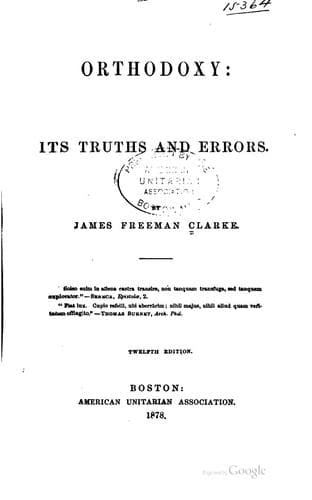
Orthodoxy: Its Truths And ErrorsClarke, James Freeman
Religion
Orthodoxy: Its Truths And Errors
Clarke, James Freeman
Unitarianism
The principal points of the teaching of Jesus concerning the life which
follows the dissolution of the body are these: _First._ As against the
Sadducees, he argues that the dead are living (Matt. 22:31, and the
parallel passages), from the simple fact that God calls them _his_. If God
thinks of them as _his_, that is enough. His thinking of them makes them
alive. No one can perish while God is thinking of him with love. Such an
argument, carrying no weight to the mere understanding, is convincing in
proportion as one is filled with a spiritual conception of God.
_Secondly._ Jesus abolishes death by teaching that there is no such thing
to the soul which shares his ideas concerning God and the universe. This
is implied in the phrases, “He that liveth and believeth in me shall never
die.” (John 11:26.) “He that believeth on me hath everlasting life.” (John
6:47.) “I am the living bread, whereof if a man eat, he shall live
forever.” (John 6:51.) “Whoso eateth my flesh, and drinketh my blood, hath
eternal life.” (John 6:54.) “If a man keep my saying, he shall never see
death.” Here, “eating Christ’s flesh, and drinking his blood,” is plainly
equivalent to “keeping his saying,” and “believing on him.” As “food which
we eat and drink changes itself so as to become a part of our own body by
assimilation,” so Christ intends that his truth shall not be merely taken
into the memory, and reproduced in words, but shall be taken into the
life, and reproduced in character. _Thirdly._ He teaches that as feeding
on his truth changes our natural life into spiritual life, and lifts
temporal existence into eternal being, so it will also place us outwardly
in a higher state and higher relations, to which state he applies the
familiar term the “resurrection” or “ascent,” the “going up.” “I will
raise him up at the last day.” The “last day,” in Jewish and New Testament
usage, means the Messianic times, as appears from such passages as Acts
2:17, where the term is used of the day of Pentecost; Heb. 1:2, “hath in
these last days spoken unto us by his Son;” 1 John 2:18, “Little children,
it is the last time.” Jesus tells his disciples that he is going to the
Father (John 14:15), in whose house are many mansions, where he is to
prepare a place for his disciples. (John 14:2.)
That “resurrection” was understood to mean a present higher state, and not
a future return to life, appears also from its use by the apostles.
Christians are spoken of as having already “risen with Christ” (Col. 3:1);
“risen with him in baptism” (Col. 3:1); walking “in the likeness of his
resurrection” (Rom. 6:5). And, no doubt, it was by making this idea of a
present resurrection too exclusive, that some Christians maintained that
it was wholly a present resurrection, and not at all future—that “it was
past already.”
Public-domain text, read in full here on John Shaqi.
Reviews
Reviews
No reviews yet
Be the first to share your thoughts on this work.
Elsewhere in the archive
Join the Discussion
Join the discussion
Sign in to leave a comment or review.
Sign InorCreate an account