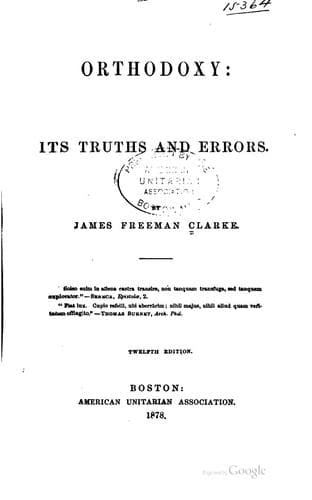
Orthodoxy: Its Truths And ErrorsClarke, James Freeman
Religion
Orthodoxy: Its Truths And Errors
Clarke, James Freeman
Unitarianism
As we look back through the eighteen centuries of Christian history, we
can observe many events which may now be seen to have been each a coming
of Christ. When, at the destruction of Jerusalem, the Mosaic theocracy
went down before the iron power of Rome, amid those scenes of horror the
firmest believers in Christ might have feared only evil. It seemed to be
the overthrow of everything most sacred—the triumph of Paganism over the
worship of Jehovah. Yet what was the result? Jesus then ceased to be the
Jewish Messiah, and began to reign over all nations as the world-teacher,
the Son of God, the prophet for mankind. Since then, more and more, the
world has gone to him as to its great Master. This, therefore, was a
coming of Christ.
Look again. The early centuries are disgraced with theological wars.
Fierce conflicts are carried on about the Trinity, and the rank of Jesus
in the universe. All regard for the pure, divine truth of Christianity
seems forgotten in the fury of these controversies. Yet, nevertheless,
amid all the absurdity and contradiction, one truth emerges, everywhere
recognized—that in Jesus was something divine; that God was more fully
manifest in him than elsewhere; that he is the moral image of the Infinite
One. This is another coming of Christ. He comes now not merely as a
prophet, but as the revealer of divine love and truth, in his own
character. The theological doctrines, in which this truth has been
wrapped, are the husks and shells which the world will throw away. But
throughout Christendom the idea of God is derived from the character of
Jesus, and in this way Jesus has come to rule the hearts of men as their
divine King.
Other centuries passed by, and we find new and strange ideas taking
possession of men’s minds. A horror of life, a dread of the sins of the
world, drive men into the desert, to live as hermits and anchorites.
Thousands and tens of thousands of monks withdrew from the world into the
wilderness. All Christianity appeared to be changing into a new form of
heathenish, self-inflicted torture. Its blessed humanity, its genial
influences on social life, seemed to be fast disappearing. Nevertheless,
out of all this error one truth emerged, one Christian idea was
developed—that of self-discipline and self-culture. And in the development
of this idea Christ came to reign _over the individual soul_ as its
Master, Guide, and Redeemer from all sin.
Public-domain text, read in full here on John Shaqi.
Reviews
Reviews
No reviews yet
Be the first to share your thoughts on this work.
Elsewhere in the archive
Join the Discussion
Join the discussion
Sign in to leave a comment or review.
Sign InorCreate an account