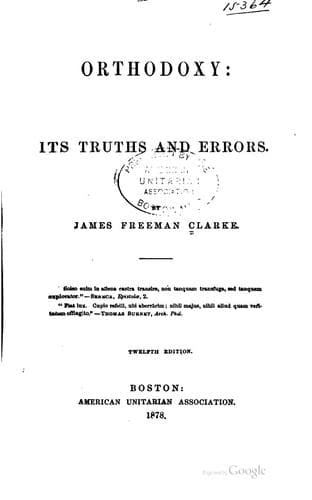
Orthodoxy: Its Truths And ErrorsClarke, James Freeman
Religion
Orthodoxy: Its Truths And Errors
Clarke, James Freeman
Unitarianism
After this arose the Papacy. The Church, as a powerful institution, became
ambitious to rule the state and the world. A spiritual despotism appeared,
surrounding itself with earthly splendor, grasping the sword of earthly
power, and the farthest removed from the humble and gentle spirit of its
Master. It would tolerate no opposition to its will, in high places or
low. It hurled its thunders at the head of kings, and sent crusading
armies to persecute and torture the peasants of the Piedmont valleys.
Nothing could seem more full of the spirit of Antichrist than this
spiritual despotism embodied in the Papacy. And yet, even through this
evil there was developed a truth—that there was something in the world
higher than kings, greater than the state. Papacy, with all its evils, was
a standing proof, in an age of brute force, of the supremacy of mind over
matter. So that, even here, the pride and selfishness of the priests and
the popes have been overruled, in the providence of God, to give
ascendency to a Christian idea, and to cause Christ to come as the King of
the world.
Consider another important event in the history of Europe: the conversion
of the barbarous tribes to Christianity. When the nations of the north
poured from the forests of Germany and the deserts of Scandinavia over the
Roman empire,—when Goths and Vandals, Franks, Lombards, and Normans,
quenched the light of civilization and brought the dark ages over
Europe,—how terrible seemed the gloom, and how hopeless the prospects, of
the human race! But we now see the result in modern civilization. We see
all these different nations subdued by the power of Christianity, and a
new unity, a higher harmony, as the result. We see the great idea of the
unity of the race, the harmony of nations, resulting from all this
darkness and misery. So Christ has come again as the Prince of Peace,
breaking down the partition walls, and proclaiming a brotherhood of man.
Let us look at one more event of history—the Lutheran Reformation. What
evils attended it! What wars came out of it! How has the impulse to
freedom given by Luther degenerated into licentiousness, run out in
infidelity and unbelief! And yet, when we consider the ideas of personal
responsibility and individual independence which have been born of
it,—when we consider what an impulse it has given to thought, to free
inquiry, to earnest investigation of truth, all the results of this
fruitful principle,—we cannot doubt that this also was a coming of Jesus,
the unfolding of a new and higher power in Christianity.
Public-domain text, read in full here on John Shaqi.
Reviews
Reviews
No reviews yet
Be the first to share your thoughts on this work.
Elsewhere in the archive
Join the Discussion
Join the discussion
Sign in to leave a comment or review.
Sign InorCreate an account