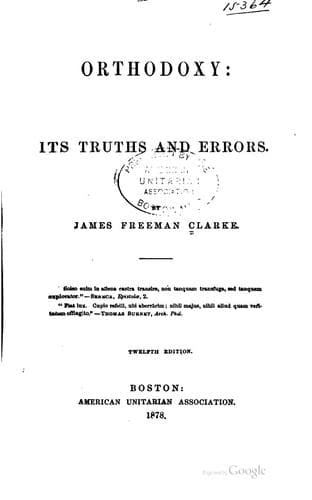
Orthodoxy: Its Truths And ErrorsClarke, James Freeman
Religion
Orthodoxy: Its Truths And Errors
Clarke, James Freeman
Unitarianism
Thus has Christ come from age to age, and in the midst of apparent
failure, increasing error, growing unbelief, and all forms of human
wickedness, has acquired new power over the human mind. At the present day
he is more the King of the world than ever. When he seems to go, then he
comes. When iniquity most abounds, then he is nearest. When love grows
cold in the hearts of his disciples, then a new impulse of faith is about
to be given. When false prophets rise up and deceive many, then new
champions of the truth are near at hand. Christ comes amid wars and
persecutions. He comes unexpectedly, like the thief in the night; comes
without observation; and while men say, “Lo, here!” and “Lo, there!” the
kingdom of heaven is in the midst of them. He is not to be found in the
desert, nor in the secret chambers; neither in public nor private; located
neither in this nor that particular place; incarnate neither in this nor
that particular person. But Christ comes like the lightning, seen over the
whole heaven at once, in a new spirit pervading all parts of life, all
parts of society.
§ 6. Relation of the Parable of the Virgins, and of the Talents, to
Christ’s Coming.
We now see what is meant by the parable of the foolish and wise virgins,
and of the talents, which follows it. We see their application to this
description of Christ’s coming. If the coming of Christ be thus
unexpected, he will not be recognized by the sleeping servant, nor by
those who beat their fellow-servants. Slothful Christians who make no
effort to improve, persecuting Christians who spend their time in
denouncing heretics, and saying, “My Lord delayeth his coming,” never
understand the signs of the times, nor recognize any new influx of divine
light in the world. At each new coming of Christ those who have been
faithful are rewarded by more light. To those who have, shall be given,
and the faithless lose what they had before. From him who hath not, shall
be taken away even what he seems to have. The capacity of seeing Christ
when he comes, of recognizing him in any new manifestation of truth,
depends on his previous fidelity.
§ 7. Relation of the Account of the Judgment by the Messiah, in Matt. ch.
25, to his Coming.
Public-domain text, read in full here on John Shaqi.
Reviews
Reviews
No reviews yet
Be the first to share your thoughts on this work.
Elsewhere in the archive
Join the Discussion
Join the discussion
Sign in to leave a comment or review.
Sign InorCreate an account