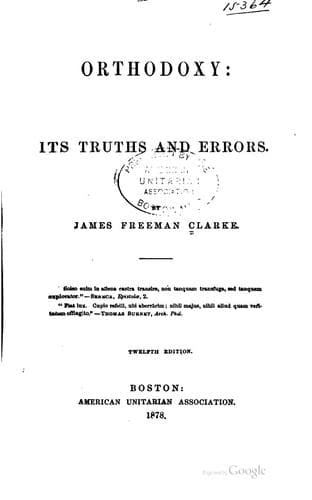
Orthodoxy: Its Truths And ErrorsClarke, James Freeman
Religion
Orthodoxy: Its Truths And Errors
Clarke, James Freeman
Unitarianism
But what is meant by the judgment described in the 25th chapter of
Matthew, commencing, “When the Son of man shall come in his glory, and all
the angels with him, then shall he sit upon the throne of his glory, and
before him shall be gathered all nations, and he shall separate them one
from another, as a shepherd divideth the sheep from the goats.” This
stands in such close connection with what goes before, that many refer
this also to the destruction of Jerusalem. But the moral meaning is so
prominent, that others apply it entirely to the final judgment in the
future life. The difficulties on both sides disappear if we reflect that
the principles which govern this life and the next are identical—that
whether Christ came at Jerusalem, comes to-day, or comes in the future
life, the laws of Christian retribution are the same. Wherever Christ
judges men, the sheep go to the right, and the goats to the left. The
generous, humane, and disinterested hear always the words, “Come, ye
blessed of my Father; inherit the kingdom prepared for you from the
foundation of the world.” The judgment in this world, it may be, is only
heard in the depths of the soul. It may be that no other mortal knows of
it. Still it is the voice of Christ which speaks. Still it is the real
kingdom which they inherit. The judgment in the future life, may be or may
not be, before assembled multitudes whom no man can number, and the
kingdom then inherited may be one shared with the angels, and extending
over worlds. Still the sentence is the same in both cases. The judgment of
Christ is one in all worlds. It was, and is, and shall be. Jesus Christ is
the same yesterday, to-day, and forever.
It may be said, this is to make the coming of Christ merely figurative—the
coming of ideas and principles only; only the coming of his religion; and
this is but an invisible abstraction. We reply, that according to our
view, Christianity cannot be conceived of as an abstraction, apart from
the person of Jesus, nor can his religion come unless he comes with it.
Jesus is with us always, in the world always, and none the less really,
because invisibly. It is no figure of speech to say that Christ is with
his Church, and with his truth; that where it goes, he goes; that when he
comes, it comes. It may even be that his presence will not always be an
invisible one. It may be that what we now believe, we shall one day see
and know. But then those only will recognize their Master’s presence who
are awake and watching for him. To the others it will seem a mere illusion
or enthusiasm.
§ 8. How Christ is, and how he is not, to judge the World.
Public-domain text, read in full here on John Shaqi.
Reviews
Reviews
No reviews yet
Be the first to share your thoughts on this work.
Elsewhere in the archive
Join the Discussion
Join the discussion
Sign in to leave a comment or review.
Sign InorCreate an account