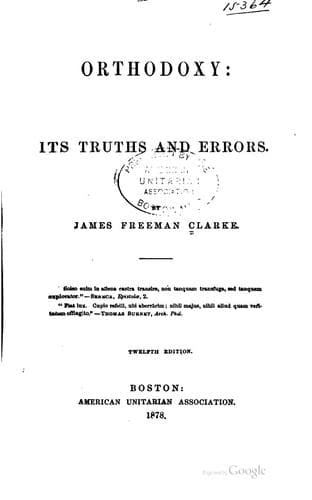
Orthodoxy: Its Truths And ErrorsClarke, James Freeman
Religion
Orthodoxy: Its Truths And Errors
Clarke, James Freeman
Unitarianism
In some places Jesus says that he is made Judge of mankind, and in other
places denies that he is to judge any one. Take, for example, the
following passages, selected because they seem to contradict each other.
They are all in the Gospel of John, and therefore the contradiction is not
in the different limitations or special misconceptions of the different
evangelists. The passages are, John 3:17; 9:39; 5:22; 8:15; 12:47. The
first is as follows: “For God sent not his Son into the world to condemn
the world, but that the world through him might be saved.” The word here
translated “_condemn_” is precisely the same as that which elsewhere is
translated “_judge_.” Consequently we should here read that God sent
Christ into the world, not to judge the world, but to save it. But the
next text referred to (John 9:39) is one in which Jesus says, “For
judgment have I come into the world, that they which see not may see, and
that they which see might be made blind.” Again (in John 5:22) it is said,
that “the Father judgeth no man, but hath committed all judgment unto the
Son.” But in the following passage (John 8:15) Jesus says, “Ye judge after
the flesh. I judge no man.” And in the last text he repeats the same idea.
“And if any man hear my words and believe not, I judge him not; for I came
not to judge the world, but to save the world.” We have, therefore, in
these passages, this apparent contradiction—that the Saviour seems in some
places to declare that he is to judge the world, and in others that he is
not to judge the world. We therefore shall do well to inquire how these
are to be understood, and in what way at all they are to be reconciled
with each other, and with the common Orthodox doctrine concerning
judgment.
And here we may remark, in passing, that there are many such seeming
contradictions as these in the New Testament, and that to the student of
the Gospels, who is a sincere seeker of truth, they are very precious and
valuable. Such a one is always glad at finding statements in the New
Testament which thus appear opposed to each other; for he knows, by
experience, that they are the very passages from which he may learn the
most, and where he will be likely to find some hitherto unnoticed truth
concerning Christ or his gospel. Such truth, however, will not be found if
he attempts to remove the contradiction by any artificial, hasty, or
forced process. If his object is merely to find proof-texts in support of
the doctrines he already believes, such paradoxes will afford him nothing
but barren difficulties, and a sphere for the exercise of sophistry and
misplaced ingenuity. But if he can bear to admit his ignorance, and is
willing to examine these difficulties in order to correct his own errors,
enlarge his own views, and learn something really new, he will often find
here the clew to deeper insight and to a larger knowledge.
Public-domain text, read in full here on John Shaqi.
Reviews
Reviews
No reviews yet
Be the first to share your thoughts on this work.
Elsewhere in the archive
Join the Discussion
Join the discussion
Sign in to leave a comment or review.
Sign InorCreate an account