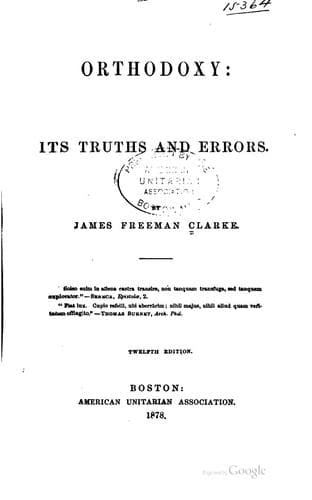
Orthodoxy: Its Truths And ErrorsClarke, James Freeman
Religion
Orthodoxy: Its Truths And Errors
Clarke, James Freeman
Unitarianism
What, then, is the explanation of these passages? In what way is Christ to
_judge_? How is it that he has come into this world for _judgment_? and
how has the Father committed _all judgment_ unto the Son? and how,
nevertheless, can be say, “_I judge no man; for I came not to judge the
world_”?
Christ’s coming was simply to do good; to make men better; to save them
from their sins; to reveal pardon; to offer salvation; to manifest God’s
love. “The law was given by Moses, but grace and truth came by Jesus
Christ.” It is the law, and not the gospel, which judges and condemns the
evil-doer. The law given by Moses, or the law given in the conscience, in
the reason, in the nature of things, written on the face of nature,
written in the soul of man,—this law has not been made more strict by the
coming of Christ. Men were bound before, by the law of nature and the law
of Moses, to love God with all their heart, and their neighbor as
themselves; and they are not bound to do more now. They were bound by
nature and reason to obey their conscience, to do the best they could
always, and they are not bound to do any more now. The whole influence of
the gospel is a bountiful and gracious one, intended and adapted to make
it easier to do right, to add new motives to virtue. Christ is no strict,
severe judge, deciding by the letter of the law, bound by his office to
show no favor or compassion, but the sinner’s advocate and friend. And
hence it may truly be said that he came not to judge the world, but to
save the world.
Public-domain text, read in full here on John Shaqi.
Reviews
Reviews
No reviews yet
Be the first to share your thoughts on this work.
Elsewhere in the archive
Join the Discussion
Join the discussion
Sign in to leave a comment or review.
Sign InorCreate an account