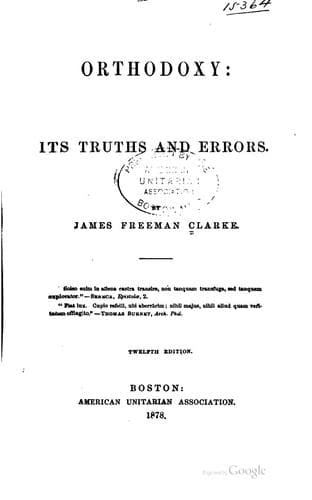
Orthodoxy: Its Truths And ErrorsClarke, James Freeman
Religion
Orthodoxy: Its Truths And Errors
Clarke, James Freeman
Unitarianism
Nevertheless, it is also true that the greatest blessings and the best
gifts of God are also judgments. They test the character. They show what
it is. According to the state of mind and heart in which a man is, so does
he receive, or reject, or neglect the offered good. If he loves light, he
comes to the light. If he loves darkness, he goes away. If his deeds are
good, he gratefully receives any revelation which brings him nearer to
God. If his deeds are evil, he rejects such revelation, avoids it,
dislikes the thought of it. So it necessarily is that the best and kindest
of men who wishes only to do good to all, nevertheless, by his very
presence and his offers of good, judges and condemns the wicked. But what
are the judgment and the sentence? Simply this—that light has come into
the world, and that they have chosen darkness rather than light, because
their deeds are evil. Therefore it was necessarily the case that the
coming of Jesus into the world was a judgment, and that though he
everywhere went with the purpose of saving and blessing men, yet that he
necessarily was also a judge. The thoughts of many hearts were revealed by
his presence. The pure in heart came to him in humility, penitence, and
faith. The proud in heart, the self-willed, the self-righteous, turned
away from him, and so judged themselves unworthy of receiving his truth.
The Galilean peasants, the common people, heard him gladly. The Scribes
and Pharisees murmured against him and rejected him. This was really a
judgment on both: the sheep went to the right hand, and the goats to the
left. Thus it is a law of human nature that all high truth by its coming
judges men, and shows by its influence upon them what is their real state.
And in this way, as Christ’s truth was the highest of all, so he was, and
is, a judge in the highest sense. But this is not quite all. The coming of
such truth not only shows the good and evil which are in men, but it
develops them, brings them out, increases the good, increases also the
evil. It is necessarily so; it cannot be otherwise. When good comes to us,
if it does not make us better, it makes us worse. Truth and goodness are
like the magnet. They have two poles. They attract and they repel. Thus it
was written that the coming of Jesus would be for the fall or the rising
of many. Thus he said, “For judgment I have come into the world, that
those which see not may see, and that those who see may be made blind.”
Peter was made better, Judas was made worse, by being in the company of
Christ. His coming was not only judgment, but also reward and punishment.
He came to the fishermen of Galilee: they were pure in heart, they were
lovers of truth and goodness, and his coming transformed them into
apostles, saints, and martyrs. He came to the Scribes and Pharisees: they
were not pure in heart. They were proud of their position, their
influence, their piety, and his coming transformed them into murderers.
Public-domain text, read in full here on John Shaqi.
Reviews
Reviews
No reviews yet
Be the first to share your thoughts on this work.
Elsewhere in the archive
Join the Discussion
Join the discussion
Sign in to leave a comment or review.
Sign InorCreate an account