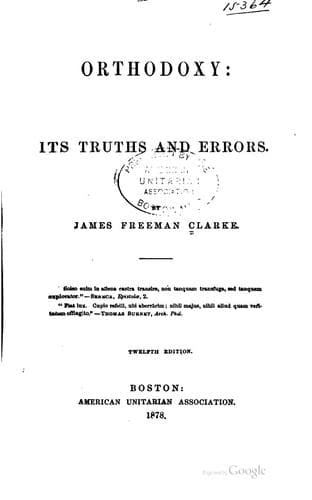
Orthodoxy: Its Truths And ErrorsClarke, James Freeman
Religion
Orthodoxy: Its Truths And Errors
Clarke, James Freeman
Unitarianism
We are now prepared to decide what is meant by Jesus in saying that he
came to judge the world, and yet that he came not to judge, but to save.
It was not the purpose of his mission to judge. The direct object of his
coming was not to judge, but to save; but indirectly, and as a matter of
necessity, one of the consequences of his coming was, that men were judged
by the word which he spoke, by the truth which he manifested, by the
holiness of his life, by the bliss which he offered, and which they
rejected. And yet it was true that he did not judge them, and that he did
not mean to judge them. They were already judged by their own choice and
determination. Therefore he says, “He who believeth not on me is judged
already, because he hath not believed on the name of the only begotten Son
of God.” It was not the will of Christ, but the truth itself, which
pronounced the sentence upon him. “The word that I have spoken, the same
shall judge him at the last day.” And thus it is said, that God is the
Judge of all, and yet again, that the Father judgeth no man, but hath
committed all judgment unto the Son, and hath given him authority to
execute judgment also, because he is the Son of man. The explanation is,
that men are judged by the truth. But this truth is not abstract, but the
truth embodied in the life and teaching of Jesus. God does not come into
the world himself to show men their sins, but he embodies his truth and
holiness in the life of his Son, and so judges the world.
In giving this explanation, we have looked steadily at the essential thing
in judgment. We have regarded the substance, not the form. If we think of
judgment as something outward, the judge seated on his throne, the
criminal standing before him, and a formal sentence pronounced, of
acquittal or condemnation, we confess that we should find it difficult to
reconcile these different passages of Scripture, some of which declare
that Christ is to be the judge, and others that he is not to be. But what
is the essential thing in judgment? It is that justice shall be done, and
that truth and right shall be vindicated; that the good shall be rewarded,
and the wicked punished; that virtue and truth shall be seen and
recognized in the consciences of men for what they are. This is the
essential thing. _How_ this is done, whether in an open tribunal, before
the assembled universe, or in the secret places of every man’s soul,
belongs not to the essence, but to the form, and is comparatively
unimportant.
§ 9. When Christ’s Judgment takes Place.
Public-domain text, read in full here on John Shaqi.
Reviews
Reviews
No reviews yet
Be the first to share your thoughts on this work.
Elsewhere in the archive
Join the Discussion
Join the discussion
Sign in to leave a comment or review.
Sign InorCreate an account