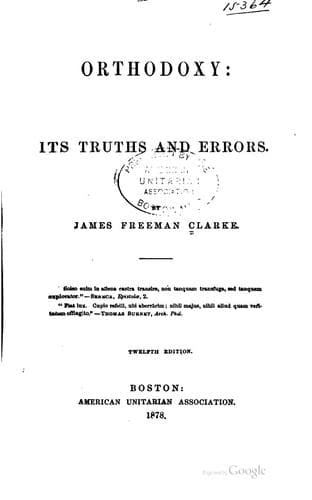
Orthodoxy: Its Truths And ErrorsClarke, James Freeman
Religion
Orthodoxy: Its Truths And Errors
Clarke, James Freeman
Unitarianism
Nevertheless, there is a more important question to be answered in
relation to the _time_ of judgment. When is the judgment? For it may be
thought, from what we have said, that we consider judgment as taking place
only in this world. But such is not the fact. Christ’s judgments take
place at Christ’s coming, whether here or hereafter. Whenever Christ
comes, he comes to judge. His first coming, in Judea, was a judgment; and
he said, “_Now_ is the judgment of the world.” His coming judged all those
who were near him; revealed the state of their minds and hearts; showed
them what they were. Wherever he went, men arranged themselves at once
according to their real characters, and the thoughts of many hearts were
revealed.
It is true that people at that day did not understand that they were thus
condemning themselves. They did not know that the awful judgment of God
was being pronounced upon them; that they were standing before his bar in
the presence of angels. They did not know that the day of judgment had
come, and that they were giving an account of every idle word even then.
But so it was. When they scoffed at Jesus and said, “He is a gluttonous
man and a wine-bibber,” they may have forgotten their words almost before
they left their mouths. But there they stand, recorded against them
forever—an everlasting proof of their blindness of mind and their hardness
of heart. When the penitent woman brought the ointment and anointed the
feet of Jesus, and bathed them with her tears, little did she think that
it was her day of judgment also, and that the approving sentence of her
act would be read by angels in heaven and countless myriads on earth. None
of them knew that it was a judgment then; but it was so.
But was that the only judgment? No; for whenever Jesus comes, he comes to
judge; and since that, his first coming, he has come again and again to
individuals and to the world, and every coming has been a new judgment on
the state of the human mind and heart. It has therefore been well said,
that the history of the world is the judgment of the world. And it is
always true that this judgment is not understood when it is pronounced,
but is seen and recognized afterwards. It is so with individuals; it is so
with communities. Who is there who, in looking back over his past life,
does not witness many an hour in which the truth has come to him, and he
refused to admit it, and so sentenced himself to receive a lie? in which
he has had opportunities of improvement, opportunities of doing good, and
has refused to accept them, and so the talent has been taken from him and
given to another. This is the judgment—that light has come into the world,
and we have chosen darkness. At the time we did not know it: blinded by
prejudice, heated by passion, we rushed recklessly on. But sooner or later
comes the calm hour of recollection, and we see ourselves as we are.
Public-domain text, read in full here on John Shaqi.
Reviews
Reviews
No reviews yet
Be the first to share your thoughts on this work.
Elsewhere in the archive
Join the Discussion
Join the discussion
Sign in to leave a comment or review.
Sign InorCreate an account