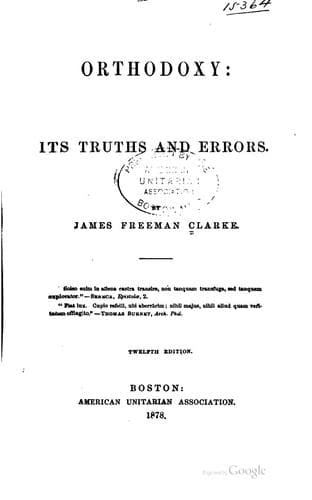
Orthodoxy: Its Truths And ErrorsClarke, James Freeman
Religion
Orthodoxy: Its Truths And Errors
Clarke, James Freeman
Unitarianism
But is this judgment which takes place in this world the only one? It is
unreasonable to think so. There are, in fact, two extreme views on this
subject. The views of those who say that all judgment is in this life, and
the views of those who say that no judgment is in this life. The New
Testament teaches that we are judged here, and that we are also judged
hereafter. The coming of Christ is here, and also hereafter; and the
judgment which commenced with his first coming will not be completed till
all of us stand before the judgment seat to give an account of the deeds
done in the body, whether they be good or evil. “It is appointed unto men
once to die, but after this the judgment.” There is a judgment in this
life, and another to come. But those will be best prepared for that future
judgment who understand the present judgment. Here is an example of the
nature of the judgments which take place in this world.
In the year 1633, an old man was brought before the Court of the
Inquisition, consisting of seven cardinals of the Roman Catholic Church,
to hear a sentence and to pronounce a recantation. The crime he had
committed was the publication of a book in the form of a dialogue,
maintaining that the sun stood still, and that the earth moved; which
proposition these holy cardinals pronounced to be absurd, false in
philosophy, and formally heretical, seeing that it was expressly contrary
to Holy Scripture. Whereupon they call upon him to abjure, execrate, and
detest these errors and heresies; prohibiting his book and condemning him
to confinement, with the penance of reciting once a week, for three years,
the seven penitential psalms. And thereupon, this man, Galileo Galilei, of
the age of seventy, on his knees, with his hands on the Gospels, abjures
his opinion.
These seven cardinals thought that they were pronouncing sentence on
Galileo and on the Copernican system. But, in reality, they pronounced
sentence on themselves and their own church. They put it upon record
forever, that the Roman Catholic Church, claiming to be infallible in
matters of faith, had, by its highest judicature, declared the Copernican
system a heresy, and thus declared its own claim to infallibility a lie.
This was the condemnation—that light had come into the world, and they
chose darkness rather than light.
So it is whenever a new truth comes into the world: it attracts the
free-minded, the lovers of truth; it repels those bound by interest or
passion. Those who believe, with Solomon, that a living dog is better than
a dead lion, leave behind them the past, and with open eyes go forward,
leaving the dead to bury the dead. Those who change the maxim, and love a
dead dog more than a living lion, turn their backs to the east and to the
rising sun, and hug their much-loved errors to their hearts. So the truth
stands in their midst, awful in its beauty, and judges them—sending away
its foes, drawing its friends to its embrace.
Public-domain text, read in full here on John Shaqi.
Reviews
Reviews
No reviews yet
Be the first to share your thoughts on this work.
Elsewhere in the archive
Join the Discussion
Join the discussion
Sign in to leave a comment or review.
Sign InorCreate an account