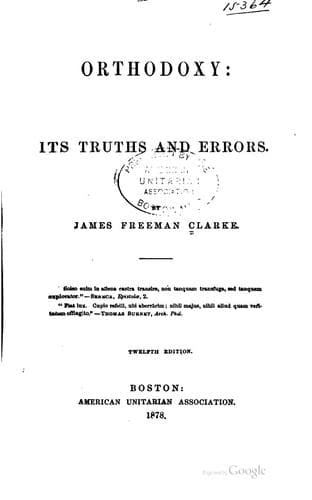
Orthodoxy: Its Truths And ErrorsClarke, James Freeman
Religion
Orthodoxy: Its Truths And Errors
Clarke, James Freeman
Unitarianism
The God of the New Testament is our Father. If he inflicts suffering, it
is for our good; “not for his pleasure, but for our profit, that we may be
partakers of his holiness.” All earthly suffering finds this solution, and
accords with the fatherly character of God in this point of view. Much, no
doubt, cannot be now fully understood. We do not _see how_ it tends to
good; but all suffering _that ends_ MAY end in good. Suffering that does
not end CANNOT end in good.
If human beings are everlastingly punished, it must either be that they go
on sinning forever, and cannot repent, lose all power of repentance, and
so cease to be moral agents, or else that they retain the power of
repenting, and therefore _may_ repent. In the first case, God continues to
punish forever those who have ceased to sin, because their freedom and
moral power have ceased; or else he punishes forever those who have
repented, and _so_ ceased sinning. In either case, God must punish
everlastingly those who have ceased to be sinners; which is incredible.
If God is a Father, he is at least _as good_ as the best earthly father.
Now, what father or mother would ever consent to place a child in a
situation where there was even a chance of its running such an awful risk?
God has _created_ us with these liabilities to sin; he has (according to
Orthodoxy) chosen and determined that we shall be born wholly prone to
evil, and sure to fall into eternal and unending ruin, unless he saves us
by a special act of grace. “What man among you, being a father,” would do
so? Custom dulls our sense to these horrors. Let us therefore imagine a
case far less terrible. Suppose that a number of parents should establish
a school, to which to send their children. Suppose they should arrange a
code of laws for the school of such a stringent character that all the
children are sure to break it. Under the school are vaults containing
instruments of torture. For each offence against the laws of the school
(offences which the children cannot fail to commit) they are to be
punished by imprisonment for life in these cells, with daily torture, from
racks, thumb-screws, and the like. A few of them are to be selected from
the rest, not for any merit of their own, but by an arbitrary decree of
the parents, and are to be rewarded (not for their superior good conduct,
but according to the caprice of the parents) with every luxury and
privilege. Among these privileges is included that of taking a daily walk
through the cells, and witnessing the horrible sufferings of their
brothers and companions, and hearing their shrieks of anguish, and
praising the JUSTICE of their parents in thus punishing some and rewarding
the rest.
Public-domain text, read in full here on John Shaqi.
Reviews
Reviews
No reviews yet
Be the first to share your thoughts on this work.
Elsewhere in the archive
Join the Discussion
Join the discussion
Sign in to leave a comment or review.
Sign InorCreate an account