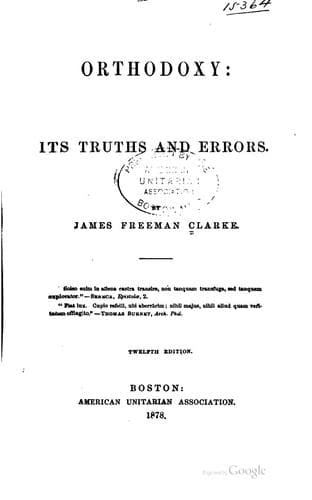
Orthodoxy: Its Truths And ErrorsClarke, James Freeman
Religion
Orthodoxy: Its Truths And Errors
Clarke, James Freeman
Unitarianism
But this, you may say, is not a parallel case. No, we grant it is not, for
what are these torments to that of a never-ending futurity? They are all
as nothing. Therefore every such comparison must utterly fail of doing
justice to the diabolic cruelty ascribed to the Almighty by this Orthodox
doctrine.
“But what right,” says the Orthodox defender of this doctrine, “have we to
reason in this way concerning the divine proceedings, by the analogy of
earthly parents? What right have we to compare God’s doings with those of
a human father?” _No_ right, perhaps, as philosophers; but as Christians
we have not only the right to do it, but it is our duty to do so. Jesus
has himself taught us to use this analogy, in order to acquire confidence
in God’s ways, and to assure ourselves that God cannot fail of acting as
we should expect a good and wise earthly parent to act. “What man is there
of _you_, whom, if his son ask bread, will he give him a stone? Or if he
ask a fish, will he give him a serpent? If _ye_ then, being evil, know how
to give good gifts unto your children, how much more shall your Father,
which is in heaven, give good things to them that ask him?” (Matt.
7:9-11.) Jesus authorizes and commands us to reason from the parental
nature in man to that in God. Instead of simply assuring us of it, on the
ground of his own authority to teach us; instead of saying, “Believe this,
because I say it,” he says, “Believe it, because it accords with your own
convictions and with human nature.”
§ 6. Attempts to modify and soften the Doctrine of Everlasting Punishment.
Public-domain text, read in full here on John Shaqi.
Reviews
Reviews
No reviews yet
Be the first to share your thoughts on this work.
Elsewhere in the archive
Join the Discussion
Join the discussion
Sign in to leave a comment or review.
Sign InorCreate an account