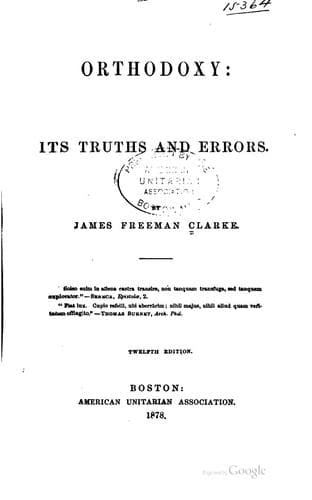
Orthodoxy: Its Truths And ErrorsClarke, James Freeman
Religion
Orthodoxy: Its Truths And Errors
Clarke, James Freeman
Unitarianism
The reasons for the late efforts to support this terrific doctrine are
probably to be found in a widespread and increasing disbelief concerning
it, pervading the churches nominally Orthodox. This has come from the
growing intelligence and progressive movements of thought in the Christian
Church. The evidences of this belief are numerous and increasing. Those
who reject the Orthodox view are a numerous body, but divided into several
parties. There are the old-fashioned Universalists, a valiant race,—men of
war from their youth,—who, under the lead of such men as Hosea Ballou and
Thomas Whittemore, have spent their lives in fighting the doctrine of
everlasting punishment. Very naturally, perhaps, they went to the opposite
extreme of opinion, and denied all future suffering. But this view has, we
think, ceased to be the prevailing one among the Universalists. The
doctrine of ultimate restoration has very generally taken its place. This
doctrine also prevails widely in other denominations; not only among the
liberal bodies, like the Unitarians, but also among Methodists,
Presbyterians, and Congregationalists. It has widely spread, as is well
known, in Germany. It was held by Schleiermacher, the father of modern
German theology. It tinges the writings of such Orthodox men as Tholuck,
Hahn, and Olshausen. Others profess to believe in everlasting punishment,
but make it a merely negative consequence of lost time and opportunity:
one will be always worse off hereafter in consequence of the neglect of
duty. Others follow Swedenborg, and make the sufferings of hell rather
agreeable than otherwise to those who bear them.
Various ineffectual attempts have indeed been made, in all ages of the
Church, to soften the austerity of this doctrine. From the days of Origen,
these merciful doctors(50) have always been trying to soften this austere
dogma, but ineffectually; for the dread of an eternal hell has been one of
the chief motives which the Church has used in converting men from sin to
holiness. Any suggestion of the possibility of future restoration would,
it is feared, cut the sinews of effective preaching. For the baptized who
are not fit for heaven the Roman Catholic Church has established, indeed,
a temporary hell, with torments of an inferior sort; for bad Catholics
there is purgatory, with the hope of ultimate escape from it; but for the
unbaptized heathen, for heretics, and for excommunicated persons, there is
nothing but eternal punishment.
Many, in all ages, have made the everlasting continuance of punishment not
absolute, but _hypothetical_—depending on the question, “Will the sinner
continue forever to sin?”(51) Others have made future punishment
_relatively_ everlasting; that is, because even the repentant sinner will
be always just so far behind the position he would have had if he had not
sinned. This, however, is taking a material view of progress, as though it
was limited, like the going of a horse, to so many miles a day.
Public-domain text, read in full here on John Shaqi.
Reviews
Reviews
No reviews yet
Be the first to share your thoughts on this work.
Elsewhere in the archive
Join the Discussion
Join the discussion
Sign in to leave a comment or review.
Sign InorCreate an account