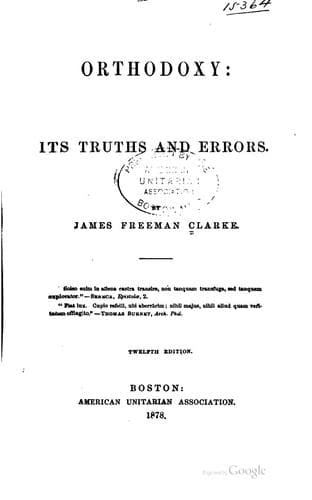
Orthodoxy: Its Truths And ErrorsClarke, James Freeman
Religion
Orthodoxy: Its Truths And Errors
Clarke, James Freeman
Unitarianism
Many of the early fathers, and some of the mediæval doctors, took milder
views of the future sufferings of the impenitent or unconverted.
Proceeding from the idea of freedom, as indestructible in the human soul,
Origen declared that, no matter how low any moral being has fallen, a way
to return is always open to him. Even the devil may, in time, regain the
highest position in the angelic hierarchy.(52) No doubt Origen admitted
the need of external conditions for this restoration; but he said, God is
able to heal the damage done to any part of his works.(53) He will restore
all things to their origin, uniting the end and the beginning, and so
becoming indeed the Alpha and Omega. This may require long processes,
through many ages.(54) Since Jesus speaks of a sin which cannot be
forgiven in this age (ἀιὼν) nor the next, it follows, says Origen, that
there is a series of ages, or worlds, through which we pass, and many of
these ages of ages (sæcula sæculorum) must pass away before all bad men
and angels shall have returned to their original state. Quoting the
passage, “The last enemy that shall be destroyed,” he says that he shall
not be destroyed as to his substance, but as to his enmity. His being was
made by God, and cannot perish; his hostile will proceeded from himself,
and shall be destroyed.
Mr. Brownson (or rather a writer in Brownson’s “Quarterly Review,” July,
1863) takes another way of softening the terrors of hell. With him too,
hell is an everlasting state; but he maintains that the Roman Church has
not made it an article of faith to believe that there is any positive
suffering therein. If you believe in an eternal hell, that is enough; you
are not precluded from softening its horrors to any extent you can. Thus
he maintains that the great Augustine allows hell to be only a negative
state—only the absence of the exquisite beatitude of heaven. This writer
(who is said by the editor to be a learned Catholic priest) asserts that
there is a growing repugnance to the popular doctrine upon eternal
punishment among the most intelligent of the Catholic laity, and this
reluctance is the chief obstacle to the reception of the faith by a large
class of non-Catholics. He attempts to meet this state of mind by showing
that neither the doctrine of St. Augustine nor that of the Catholic Church
supports this popular view, but allows a much milder one. He proceeds to
make these points:—
Public-domain text, read in full here on John Shaqi.
Reviews
Reviews
No reviews yet
Be the first to share your thoughts on this work.
Elsewhere in the archive
Join the Discussion
Join the discussion
Sign in to leave a comment or review.
Sign InorCreate an account