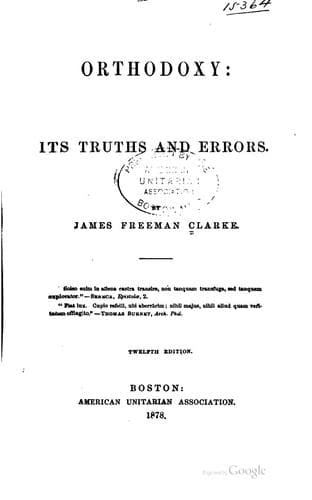
Orthodoxy: Its Truths And ErrorsClarke, James Freeman
Religion
Orthodoxy: Its Truths And Errors
Clarke, James Freeman
Unitarianism
1. St. Augustine nowhere teaches that human nature is intrinsically evil,
but he invariably teaches that it is substantially good. (“Omnis natura in
quantum natura est bona est.” “Omnis substantia aut Deus est aut ex Deo.”
De Lib. Arbit.) Therefore it follows that the very notion of _total_
depravity is impossible. St. Augustine distinctly says that “the very
unclean spirit himself is good, inasmuch as he is a spirit, but evil
inasmuch as he is unclean.” Hence, not even the nature of the devil
himself is evil. So St. Thomas (“Diabolus, in quantum habet esse, est
bonus”), “the devil, so far as he _is_, is good.”
2. St. Augustine teaches in explicit terms that existence is a good even
to angels and men who are eternally bound by the consequences of evil.
3. Eternal death, according to St. Augustine, is a subsidence into a lower
form of life, a privation of the highest vital influx from God in order to
everlasting life, or supreme beatitude, but not of all vital influx in
order to an endless existence, which is a partial and incomplete
participation in good. These sinful souls, therefore, fulfil in a measure
the end of their creation, and have a place and a function in harmony with
the general order of the cosmos. There is no trace, in this view of
Augustine, that God hates a portion of his creatures with an absolute,
infinite, and eternal hatred, and is hated by them in return. The original
act of creative love is an enduring and eternal act, in which even Satan
is included. “Their nature still remains essentially good, and far
superior in excellence and beauty to material light, which is the highest
corporeal substance.”
4. Hell, therefore (Infernus), is simply a lower state of inchoate and
imperfect being, “of saints nipped in the bud.” Infant damnation is only a
gentle sadness—“levis tristitia.” All positive suffering in hell is
probably temporal, and therefore must at last cease. The lost souls will
enjoy there quite as much as they can do here, _minus_ the temporal
sufferings of this life. They continue _natural_ beings, and therefore can
enjoy all natural joy; and that which they lose, being the “beatific
vision,” of which they have no conception, is a loss of which they are
wholly unconscious.
Swedenborg maintains, in the same way, the everlasting character of the
punishment of those who have passed the final judgment, but admits many
palliations to its sufferings. He teaches that delight is the universal
substance of heaven, and also of hell, and that evil spirits are in the
delight of evil, as good spirits in that of good. An evil spirit would be
as unhappy in heaven as a good one would be in hell.
§ 7. The meaning of Eternal Punishment in Scripture.
Public-domain text, read in full here on John Shaqi.
Reviews
Reviews
No reviews yet
Be the first to share your thoughts on this work.
Elsewhere in the archive
Join the Discussion
Join the discussion
Sign in to leave a comment or review.
Sign InorCreate an account