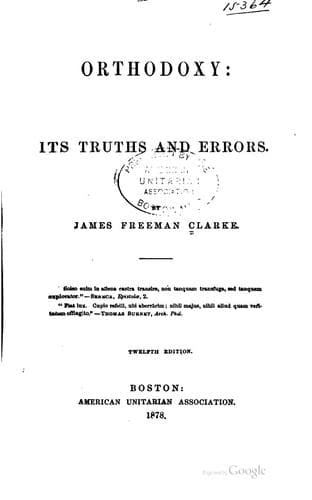
Orthodoxy: Its Truths And ErrorsClarke, James Freeman
Religion
Orthodoxy: Its Truths And Errors
Clarke, James Freeman
Unitarianism
But what, then, is the vital truth in the doctrine of eternal punishment?
Christ says, “These shall go away into eternal punishment.”(55) What is
this “eternal punishment”? It is commonly supposed to mean the same thing
as punishment which shall never end, or punishment continued through all
time. But this is to misunderstand both the philosophical and scriptural
meaning of the word “eternal.” Eternal punishments are the opposite of
temporal punishments: they have nothing to do with time at all; they are
punishments outside of time. To attempt to realize eternity by adding up
any number of myriads of years of time, is necessarily a failure; for time
and eternity are different things. You might as well attempt to produce
thought or love, by adding up millions of miles of distance, as, by adding
up millions of years of time, to get any idea of eternity. Eternal life,
in the language of Scripture, has nothing to do with the future or the
past. It is a present life in the soul, awakened within by the knowledge
of God and Christ. “This _is_ life eternal, to know thee, the only true
God, and Jesus Christ, whom thou hast sent.” “Eternal life and eternal
death both come from the knowledge of God and of Christ.” To one it is a
savor of life, to another of death. Eternal punishment and eternal life
are the punishments and the rewards of eternity, distinguished from those
of time, and having their root in the knowledge of God which comes through
Christ. Eternal life and eternal punishment both commence here, from the
judgments which takes place now: but the last judgment, or the judgment of
the last day, is that which will take place hereafter, when the soul shall
have a full knowledge of itself and of God; see its whole life as it
really is; have all self-deceptions taken away, all disguises removed, and
know itself as it is known. God’s love, when revealed, attracts and
repels. Like all real force, it is a polar force. The one pole is its
attractive power over those who are in a truth-loving state; the other
pole is its repelling power to those who are in a truth-hating state. Love
attracts the truthful, and repels the wilful. Eternal punishment, then, is
the repugnance to God of the soul which is inwardly selfish in its
will,—loving itself more than truth and right. It is the sense of
indignation and wrath, alienation and poverty, which rests on it while in
this condition. It is the outer darkness; it is the far country; it is the
famine, which comes as a holy and blessed evil, sent to save, by bringing
to repentance, the prodigal child, who has not yet “come to himself.”
Public-domain text, read in full here on John Shaqi.
Reviews
Reviews
No reviews yet
Be the first to share your thoughts on this work.
Elsewhere in the archive
Join the Discussion
Join the discussion
Sign in to leave a comment or review.
Sign InorCreate an account