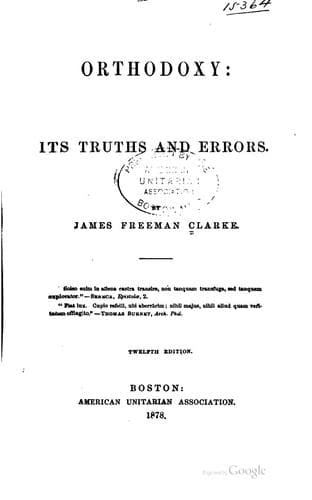
Orthodoxy: Its Truths And ErrorsClarke, James Freeman
Religion
Orthodoxy: Its Truths And Errors
Clarke, James Freeman
Unitarianism
From this knowledge of God and of itself, therefore,—from this judgment of
the last day,—will flow eternal life to the one class, and eternal
punishment or suffering to the other. Those who have been conscientious
and generous; who have endeavored faithfully to live for truth and right;
who have made sacrifices, and not boasted of them; who have clothed the
naked and fed the hungry, making the world better and happier by their
presence,—will hear the Saviour say, “Come, ye blessed of my Father,
inherit the kingdom prepared for you from the foundation of the world; for
I was hungry, and ye gave me meat.” Perhaps they have never even heard the
name of Christ; perhaps they were the Buddhists of Burmah, of whom Mr.
Malcom speaks, who brought food to him, though a stranger to them. “I was
scarcely seated,” says he, “when a woman brought a nice mat for me to lie
on; another, cool water; and a man went and picked me a half dozen fine
oranges. None sought or expected the least reward, but disappeared, and
left me to my repose.” Or perhaps they will be the poor black women in
Africa, who took such kind care of Mungo Park, singing, “Let us pity the
white man: he has no mother to bring him milk, no wife to grind him corn.”
The reward of their fidelity will be the gift of a greater power of
goodness, coming from a knowledge of God and Christ. They were helping
Christ, though they did not know him. They will say, “Lord, when saw we
thee an hungered?” These Gentiles, without the law, who do by nature the
things contained in the law, will come to know Christ, and receive a
spiritual life—life flowing from that knowledge. On the other hand, those
who have not endeavored to do what they knew to be right will receive from
the same knowledge of God and Christ a spiritual or eternal punishment.
Perhaps they have received some of it already in this world; but a deeper
knowledge of the truth will bring a keener self-reproach. The worm that
never dies is this gnawing(56) tooth of conscience. The fire which is not
quenched is the heart still selfish, turned to evil, joined with a
conscience which sees the good. For man, as long as he is man, cannot get
away from himself. He may sophisticate himself with falsehoods, put his
conscience to sleep, and imagine that he has escaped all the penalties of
evil; but he cannot escape from himself. The longer and deeper the sleep
of conscience, the more terrible its final awakening.
Eternal punishment, therefore, is the punishment which comes to man from
his spiritual nature; from that side of man which connects him with
eternity, in contradistinction from temporal punishment, which is that
which comes from his temporal nature and the temporal world. Through the
body he receives temporal pleasure or pain from the world of time and
space; through the spirit he receives spiritual joy or sorrow from the
world of eternity and infinity.
Public-domain text, read in full here on John Shaqi.
Reviews
Reviews
No reviews yet
Be the first to share your thoughts on this work.
Elsewhere in the archive
Join the Discussion
Join the discussion
Sign in to leave a comment or review.
Sign InorCreate an account