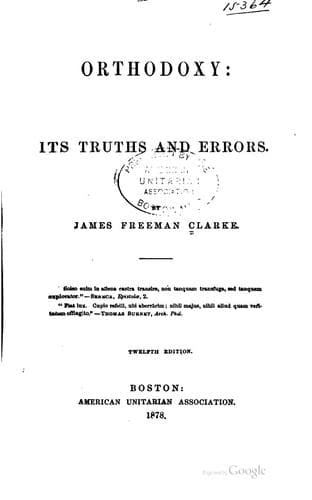
Orthodoxy: Its Truths And ErrorsClarke, James Freeman
Religion
Orthodoxy: Its Truths And Errors
Clarke, James Freeman
Unitarianism
Thus intimately are judgment and retribution connected. There is nothing
arbitrary about rewards or punishments. They follow naturally and
necessarily from the revelation of divine and eternal truth. Sooner or
later, the everlasting distinctions between right and wrong, good and
evil, make themselves seen and known. The distinctions between right and
wrong _are_ eternal.
The idea of duration is not connected with eternal punishment or eternal
life; for the idea of duration belongs to time, and not to eternity. Human
law sentences men, for crime, to be punished by imprisonment for six
months, three years, ten years, or for life; but in God’s world there is
not, and cannot be, any relation between a man’s guilt and the precise
time he is to suffer. He must suffer while he is guilty, be the time
longer or shorter. When he ceases to be guilty, he must cease to suffer.
He therefore fixes the _duration_ of his suffering himself: that makes no
part of the divine sentence. If he judges himself unworthy of eternal life
during five, ten, one hundred, or ten thousand million years, that is for
himself to say. God will never save him against his will; and God can
wait. The sphere of time belongs to man’s freedom; that of eternity, to
the freedom of God.
And this reconciles the philosophic difficulty. Man, being _free_, can
postpone his submission and obedience _indefinitely_; but, being finite,
cannot postpone it _infinitely_. At any point of time, he may still
resolve to resist the influx of eternal life, and continue in the sphere
of death: but eternity surrounds time, and infolds it; and in eternity
God’s purposes will be realized, and every knee bow, of things in heaven,
and in earth, and under the earth. Universal harmony must prevail at last.
“Eternal” and “everlasting” are two wholly different ideas. We fully
believe in eternal punishment, but not in everlasting punishment. Eternal
life is spiritual life: eternal suffering is spiritual suffering.
The whole of antiquity recognizes this distinction; and the Bible is
saturated with it. When Jesus says, “He who believes in me has _eternal
life_ abiding in him,” there is nothing about duration intended in that.
When he says, “This is _life eternal_, to know thee the only true God,”
there is nothing about duration implied. It is the quality of the life
which is conveyed—spiritual life, life flowing from the sight of God and
Christ.
Public-domain text, read in full here on John Shaqi.
Reviews
Reviews
No reviews yet
Be the first to share your thoughts on this work.
Elsewhere in the archive
Join the Discussion
Join the discussion
Sign in to leave a comment or review.
Sign InorCreate an account