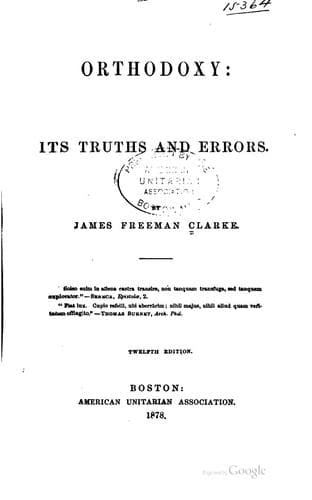
Orthodoxy: Its Truths And ErrorsClarke, James Freeman
Religion
Orthodoxy: Its Truths And Errors
Clarke, James Freeman
Unitarianism
We believe in eternal punishment; but, because it is eternal, therefore it
is not everlasting. Eternal suffering, flowing from the sight of the
eternal truth and love of God, is real suffering, because it involves the
sight of sin, the consciousness of failure, the deep conviction of what we
ought to do and have not done; but all this leads to repentance and
salvation. When the Lord turned and looked on Peter, Peter went into
eternal suffering. He saw his own guilt and the infinite goodness of his
Master at the same time. The one produced penitence; the other, hope. But,
when Judas hanged himself, he did _not_ go into eternal punishment, but
into temporal. He saw his own baseness and his own folly; but he did not
see God’s love. If he had seen God’s love and Christ’s pardoning mercy,
together with his sin, he would not have hanged himself; but, like Peter,
he would have repented, and gone forth to preach the gospel.
When we see God’s truth and love, we go into eternal life or into eternal
suffering, according to the direction of our lives and hearts. If we are
following Christ, and trying to do right,—if we are not selfish, but
generous,—then the sight of God’s love and truth in Christ leads us
directly into spiritual joy; but if we are selfish, and seeking only our
own good, if we are indifferent to the rights of our fellow-men, then we
go into eternal or spiritual suffering.
The force of eternal punishment, therefore, is not in the statement that
it is never to end; nor in any description, however vivid, of outward
physical torments. Such descriptions produce excitement, agitation,
terror. But this is not _conviction_. The doctrine, not being in harmony
with the attributes of God or the nature of man, can never be sincerely or
profoundly believed. It is inwardly opposed by every Christian conviction
in the human soul; for it is not Christian, but Pagan. It is a relapse
into Paganism, an importation of Pagan terrors into Christianity. It
degrades every soul that teaches it, or that accepts it, in the same way
that idolatry degrades it. It puts a veil between the soul and the true
God.
But the true Christian doctrine of eternal punishment is, that the soul
which sins shall eternally suffer; that there is an eternal distinction
between truth and falsehood, good and evil; that spiritual distinctions
are positive and real; and that evil is not a mere negative thing,
implying a little less of good, but positive, being the state of a soul
which is repelled, not attracted, by the divine goodness; which keeps away
from God, as the shadow keeps on the side of the globe which is away from
the sun.
Public-domain text, read in full here on John Shaqi.
Reviews
Reviews
No reviews yet
Be the first to share your thoughts on this work.
Elsewhere in the archive
Join the Discussion
Join the discussion
Sign in to leave a comment or review.
Sign InorCreate an account