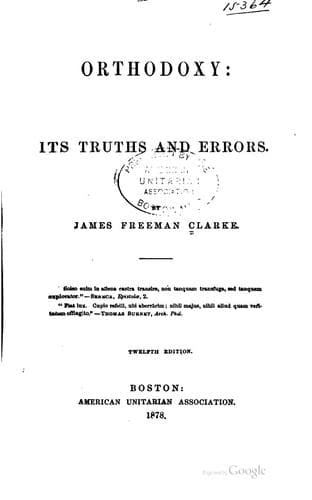
Orthodoxy: Its Truths And ErrorsClarke, James Freeman
Religion
Orthodoxy: Its Truths And Errors
Clarke, James Freeman
Unitarianism
Again: eternal suffering is the suffering of eternity, as distinguished
from temporal suffering, which has its root in time. This is something
which comes from within, while temporal suffering comes from without. Till
man is reconciled to God by obedience and love, he has the sentence of
death in himself. This suffering is not arbitrary, but fixed in the nature
of things. As a sinner, man must be eternally separated inwardly from God,
and therefore from bliss. His hell is within him, not without. And it is
also here, as well as hereafter, since eternity is here, no less than
time.
In this view of eternal punishment, there is an important truth—truth
essential to the just spiritual growth of man. It is needed to resist the
tendency to make light of sin. It is needed to oppose the view which makes
evil, as well as good, a natural growth, and teaches that all men are on
their way upward, and will ultimately fall into heaven by some specific
levity. It is needed to remind us that we must choose whom we will serve,
and that, consciously or unconsciously, we are at all moments tending
either upward or downward—either towards God or away from him.
This is the great truth which is often lost sight of by Liberal
Christianity, and by that easy optimism which declares that “whatever is,
is right;” but darkly taught, because dimly seen, by Orthodoxy. Pagan in
its form, there is often an essentially Christian idea communicated by the
Orthodox pulpit. The Pagan form may be neglected and disbelieved: the
Christian impression may remain. It tightens the nerves of the soul, as a
cold bath invigorates the body made languid by too much warmth and ease.
Yet, as long as the Pagan form remains, the interior truth is shorn of its
full power. Let us pray that the truth, divested of its dark errors, may
at last be recognized by the Christian Church. For very often the words of
a great writer and thinker (who also was an earnest opponent of the
Orthodox form of this doctrine) recur to us in these studies: “Few see the
things themselves, but only the forms of things, in the mirror of
reflection, as images. But we shall at last see the things themselves face
to face, as it is said, and without a veil, if it please God, in part
before the close of this present life, more fully in the life to
come.”(57)
§ 8. How Judgment by Christ is connected with Punishment.
Public-domain text, read in full here on John Shaqi.
Reviews
Reviews
No reviews yet
Be the first to share your thoughts on this work.
Elsewhere in the archive
Join the Discussion
Join the discussion
Sign in to leave a comment or review.
Sign InorCreate an account